
Build a custom Trainer
PyTorch is powerful, but as projects grow, Fabric lets you build a modular, scalable trainer that abstracts away repeated code or boilerplate, without giving up control. This tutorial teaches you how to build your own Trainer with Lightning Fabric.
Note: This tutorial is intermediate-to-advanced. We assume you know basic Python, some PyTorch, and want to learn how real production trainers work.
Problems scaling PyTorch
When training models, you can either fully DIY everything in plain PyTorch - managing distributed training, checkpointing, modularity, and reusability yourself - or use a framework like PyTorch Lightning. PyTorch alone works great for small projects, but as projects grow, the surface area for mistakes scales exponentially. Distributed training, saving and resuming correctly, maintaining modular and reusable code, and staying up-to-date with the latest techniques all become major challenges. New projects often fork old training scripts, leading to fragile codebases that are hard to maintain and update consistently. Instead of focusing on advancing your models, you spend more and more time just maintaining your training infrastructure.
A better way with Fabric
PyTorch gives you building blocks - Fabric gives you the finished construction tools. Instead of reimplementing device management, checkpointing, precision handling, and scaling logic yourself every time, Fabric provides a lightweight layer that abstracts the repeatable infrastructure - while still letting you fully control your training loop. You can build your own custom, private trainer: modular, scalable, and tailored exactly to your project’s needs. You keep the simplicity and flexibility of PyTorch while gaining the stability, structure, and production readiness of Lightning - without forcing yourself into a full framework if you don't want to.
Final result
Here's how it looks when you are done implementing each file here. This code (run.py) will train a model using your custom Trainer we create in this tutorial
# Import necessary libraries: Torch, TorchMetrics, Custom Trainer, Lightning utilities
import torch
from torchmetrics.functional.classification import accuracy
from trainer import MyCustomTrainer
import lightning as L

class MNISTModule(L.LightningModule):
    def __init__(self) -> None:
        super().__init__()

        self.model = torch.nn.Sequential(
            torch.nn.Conv2d(in_channels=1, out_channels=16, kernel_size=5, stride=1, padding=2),
            torch.nn.ReLU(),
            torch.nn.MaxPool2d(kernel_size=2),
            torch.nn.Conv2d(16, 32, 5, 1, 2),
            torch.nn.ReLU(),
            torch.nn.MaxPool2d(2),
            torch.nn.Flatten(),
            torch.nn.Linear(32 * 7 * 7, 10),  # fully connected layer to 10 classes
        )

        self.loss_fn = torch.nn.CrossEntropyLoss()

    def forward(self, x: torch.Tensor):
        return self.model(x)

    def training_step(self, batch, batch_idx: int):
        x, y = batch
        logits = self(x)
        loss = self.loss_fn(logits, y)
        accuracy_train = accuracy(logits.argmax(-1), y, num_classes=10, task="multiclass", top_k=1)
        return {"loss": loss, "accuracy": accuracy_train}

    def configure_optimizers(self):
        optim = torch.optim.Adam(self.parameters(), lr=1e-4)
        return {
            "optimizer": optim,
            "scheduler": torch.optim.lr_scheduler.ReduceLROnPlateau(optim, mode="max", verbose=True),
            "monitor": "val_accuracy",
            "interval": "epoch",
            "frequency": 1,
        }

    def validation_step(self, *args, **kwargs):
        return self.training_step(*args, **kwargs)

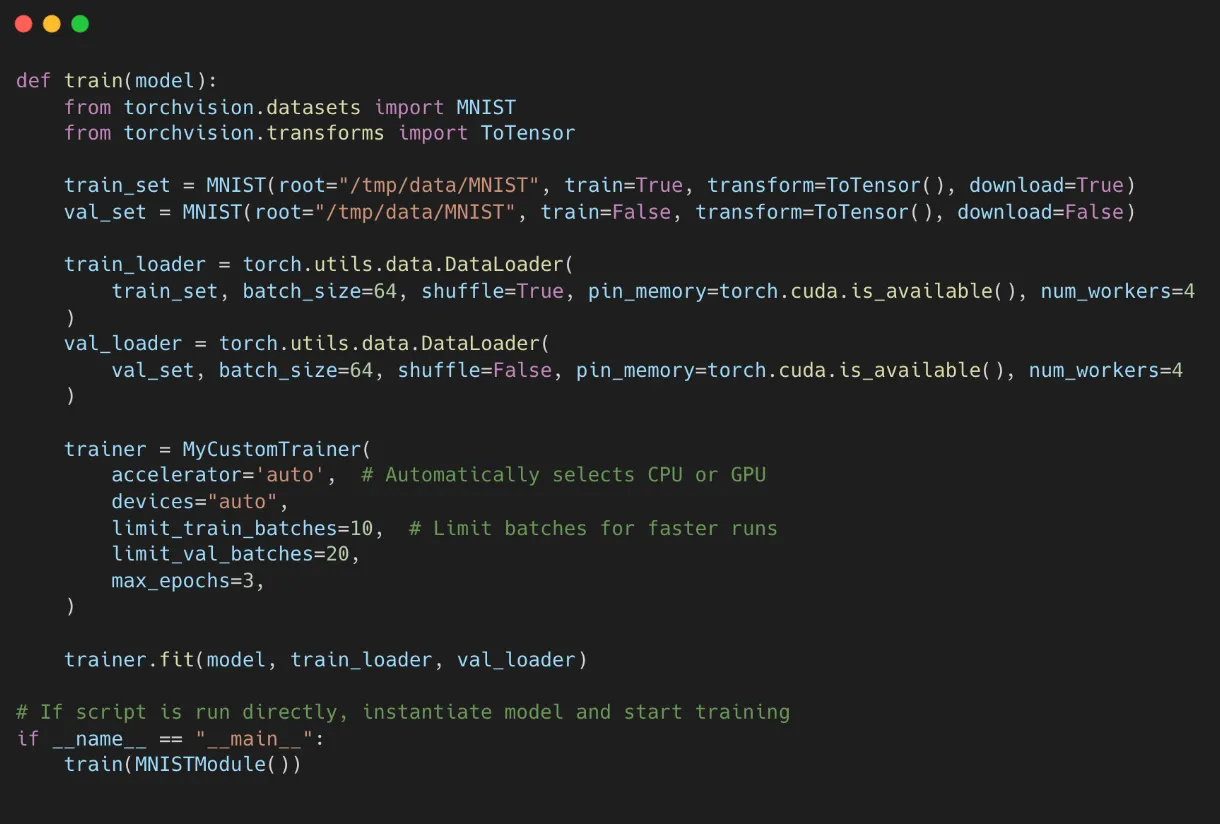
def train(model):
    from torchvision.datasets import MNIST
    from torchvision.transforms import ToTensor

    train_set = MNIST(root="/tmp/data/MNIST", train=True, transform=ToTensor(), download=True)
    val_set = MNIST(root="/tmp/data/MNIST", train=False, transform=ToTensor(), download=False)

    train_loader = torch.utils.data.DataLoader(
        train_set, batch_size=64, shuffle=True, pin_memory=torch.cuda.is_available(), num_workers=4
    )
    val_loader = torch.utils.data.DataLoader(
        val_set, batch_size=64, shuffle=False, pin_memory=torch.cuda.is_available(), num_workers=4
    )

    trainer = MyCustomTrainer(
        accelerator='auto',  # Automatically selects CPU or GPU
        devices="auto",
        limit_train_batches=10,  # Limit batches for faster runs
        limit_val_batches=20,
        max_epochs=3,
    )

    trainer.fit(model, train_loader, val_loader)

# If script is run directly, instantiate model and start training
if __name__ == "__main__":
    train(MNISTModule())
run.py
Let's break it down
init
The init method builds a small convolutional neural network for MNIST digit classification and prepares the loss function for training.
def __init__(self):
    super().__init__()

    self.model = torch.nn.Sequential(
        torch.nn.Conv2d(
            in_channels=1,
            out_channels=16,
            kernel_size=5,
            stride=1,
            padding=2,
        ),
        torch.nn.ReLU(),
        torch.nn.MaxPool2d(kernel_size=2),
        torch.nn.Conv2d(16, 32, 5, 1, 2),
        torch.nn.ReLU(),
        torch.nn.MaxPool2d(2),
        torch.nn.Flatten(),
        torch.nn.Linear(32 * 7 * 7, 10),
    )

    self.loss_fn = torch.nn.CrossEntropyLoss()
forward
The forward method defines how input images are passed through the network during inference or training.
def forward(self, x: torch.Tensor):
    return self.model(x)
training_step
The training_step method runs a forward pass on a batch, computes the loss, calculates accuracy, and returns both for logging.
def training_step(self, batch, batch_idx: int):
    x, y = batch

    logits = self(x)

    loss = self.loss_fn(logits, y)

    accuracy_train = accuracy(logits.argmax(-1), y, num_classes=10, task="multiclass", top_k=1)

    return {"loss": loss, "accuracy": accuracy_train}
configure_optimizers
The configure_optimizers method defines the optimizer and learning rate scheduler for the training loop.
def configure_optimizers(self):
    optim = torch.optim.Adam(self.parameters(), lr=1e-4)

    return {
        "optimizer": optim,
        "scheduler": torch.optim.lr_scheduler.ReduceLROnPlateau(optim, mode="max", verbose=True),
        "monitor": "val_accuracy",
        "interval": "epoch",
        "frequency": 1,
    }
train
The train function sets up the MNIST datasets, prepares dataloaders, initializes the custom Trainer, and starts training the model.
def train(model):
    from torchvision.datasets import MNIST
    from torchvision.transforms import ToTensor

    train_set = MNIST(root="/tmp/data/MNIST", train=True, transform=ToTensor(), download=True)
    val_set = MNIST(root="/tmp/data/MNIST", train=False, transform=ToTensor(), download=False)

    train_loader = torch.utils.data.DataLoader(
        train_set, batch_size=64, shuffle=True, pin_memory=torch.cuda.is_available(), num_workers=4
    )
    val_loader = torch.utils.data.DataLoader(
        val_set, batch_size=64, shuffle=False, pin_memory=torch.cuda.is_available(), num_workers=4
    )

    accelerator = "cpu" if torch.backends.mps.is_available() else "auto"

    trainer = MyCustomTrainer(
        accelerator=accelerator, devices="auto", limit_train_batches=10, limit_val_batches=20, max_epochs=3
    )

    trainer.fit(model, train_loader, val_loader)
trainer.py
Here's the deep dive into building our own Trainer.
Note: This code is intermediate-to-advanced. We assume you know basic Python, some PyTorch, and want to learn how real production trainers work.
import os
from collections.abc import Iterable, Mapping
from functools import partial
from typing import Any, Literal, Optional, Union, cast

import torch
from lightning_utilities import apply_to_collection
from tqdm import tqdm

import lightning as L
from lightning.fabric.accelerators import Accelerator
from lightning.fabric.loggers import Logger
from lightning.fabric.strategies import Strategy
from lightning.fabric.wrappers import _unwrap_objects
from lightning.pytorch.utilities.model_helpers import is_overridden


class MyCustomTrainer:
    def __init__(
        self,
        accelerator: Union[str, Accelerator] = "auto",
        strategy: Union[str, Strategy] = "auto",
        devices: Union[list[int], str, int] = "auto",
        precision: Union[str, int] = "32-true",
        plugins: Optional[Union[str, Any]] = None,
        callbacks: Optional[Union[list[Any], Any]] = None,
        loggers: Optional[Union[Logger, list[Logger]]] = None,
        max_epochs: Optional[int] = 1000,
        max_steps: Optional[int] = None,
        grad_accum_steps: int = 1,
        limit_train_batches: Union[int, float] = float("inf"),
        limit_val_batches: Union[int, float] = float("inf"),
        validation_frequency: int = 1,
        use_distributed_sampler: bool = True,
        checkpoint_dir: str = "./checkpoints",
        checkpoint_frequency: int = 1,
    ) -> None:
        """Exemplary Trainer with Fabric. This is a very simple trainer focused on readablity but with reduced
        featureset. As a trainer with more included features, we recommend using the
        :class:`lightning.pytorch.Trainer`.

        Args:
            accelerator: The hardware to run on. Possible choices are:
                ``"cpu"``, ``"cuda"``, ``"mps"``, ``"gpu"``, ``"tpu"``, ``"auto"``.
            strategy: Strategy for how to run across multiple devices. Possible choices are:
                ``"dp"``, ``"ddp"``, ``"ddp_spawn"``, ``"deepspeed"``, ``"fsdp"``.
            devices: Number of devices to train on (``int``),
                which GPUs to train on (``list`` or ``str``), or ``"auto"``.
                The value applies per node.
            precision: Double precision (``"64"``), full precision (``"32"``), half precision AMP (``"16-mixed"``),
                or bfloat16 precision AMP (``"bf16-mixed"``).
            plugins: One or several custom plugins
            callbacks: A single callback or a list of callbacks. The following hooks are supported:
                - on_train_epoch_start
                - on train_epoch_end
                - on_train_batch_start
                - on_train_batch_end
                - on_before_backward
                - on_after_backward
                - on_before_zero_grad
                - on_before_optimizer_step
                - on_validation_model_eval
                - on_validation_model_train
                - on_validation_epoch_start
                - on_validation_epoch_end
                - on_validation_batch_start
                - on_validation_batch_end

            loggers: A single logger or a list of loggers. See :meth:`~lightning.fabric.fabric.Fabric.log` for more
                information.

            max_epochs: The maximum number of epochs to train
            max_steps: The maximum number of (optimizer) steps to train
            grad_accum_steps: How many batches to process before each optimizer step
            limit_train_batches: Limits the number of train batches per epoch
                If greater than number of batches in the dataloader, this has no effect.
            limit_val_batches: Limits the number of validation batches per epoch.
                If greater than number of batches in the dataloader, this has no effect.
            validation_frequency: How many epochs to run before each validation epoch.
            use_distributed_sampler: Wraps the sampler of each dataloader with a respective distributed-aware sampler
                in case of distributed training.
            checkpoint_dir: Directory to store checkpoints to.
            checkpoint_frequency: How many epochs to run before each checkpoint is written.

        Warning:
            callbacks written for the lightning trainer (especially making assumptions on the trainer), won't work!

        """

        self.fabric = L.Fabric(
            accelerator=accelerator,
            strategy=strategy,
            devices=devices,
            precision=precision,
            plugins=plugins,
            callbacks=callbacks,
            loggers=loggers,
        )
        self.global_step = 0
        self.grad_accum_steps: int = grad_accum_steps
        self.current_epoch = 0

        self.max_epochs = max_epochs
        self.max_steps = max_steps
        self.should_stop = False

        # ensures limit_X_batches is either int or inf
        if not isinstance(limit_train_batches, int):
            assert limit_train_batches == float("inf")

        if not isinstance(limit_val_batches, int):
            assert limit_val_batches == float("inf")

        self.limit_train_batches = limit_train_batches
        self.limit_val_batches = limit_val_batches
        self.validation_frequency = validation_frequency
        self.use_distributed_sampler = use_distributed_sampler
        self._current_train_return: Union[torch.Tensor, Mapping[str, Any]] = {}
        self._current_val_return: Optional[Union[torch.Tensor, Mapping[str, Any]]] = {}

        self.checkpoint_dir = checkpoint_dir
        self.checkpoint_frequency = checkpoint_frequency

    def fit(
        self,
        model: L.LightningModule,
        train_loader: torch.utils.data.DataLoader,
        val_loader: torch.utils.data.DataLoader,
        ckpt_path: Optional[str] = None,
    ):
        """The main entrypoint of the trainer, triggering the actual training.

        Args:
            model: the LightningModule to train.
                Can have the same hooks as :attr:`callbacks` (see :meth:`MyCustomTrainer.__init__`).
            train_loader: the training dataloader. Has to be an iterable returning batches.
            val_loader: the validation dataloader. Has to be an iterable returning batches.
                If not specified, no validation will run.
            ckpt_path: Path to previous checkpoints to resume training from.
                If specified, will always look for the latest checkpoint within the given directory.

        """
        self.fabric.launch()

        # setup dataloaders
        train_loader = self.fabric.setup_dataloaders(train_loader, use_distributed_sampler=self.use_distributed_sampler)
        if val_loader is not None:
            val_loader = self.fabric.setup_dataloaders(val_loader, use_distributed_sampler=self.use_distributed_sampler)

        # setup model and optimizer
        if isinstance(self.fabric.strategy, L.fabric.strategies.fsdp.FSDPStrategy):
            # currently, there is no way to support fsdp with model.configure_optimizers in fabric
            # as it would require fabric to hold a reference to the model, which we don't want to.
            raise NotImplementedError("BYOT currently does not support FSDP")

        optimizer, scheduler_cfg = self._parse_optimizers_schedulers(model.configure_optimizers())
        assert optimizer is not None
        model, optimizer = self.fabric.setup(model, optimizer)

        # assemble state (current epoch and global step will be added in save)
        state = {"model": model, "optim": optimizer, "scheduler": scheduler_cfg}

        # load last checkpoint if available
        if ckpt_path is not None and os.path.isdir(ckpt_path):
            latest_checkpoint_path = self.get_latest_checkpoint(self.checkpoint_dir)
            if latest_checkpoint_path is not None:
                self.load(state, latest_checkpoint_path)

                # check if we even need to train here
                if self.max_epochs is not None and self.current_epoch >= self.max_epochs:
                    self.should_stop = True

        while not self.should_stop:
            self.train_loop(
                model, optimizer, train_loader, limit_batches=self.limit_train_batches, scheduler_cfg=scheduler_cfg
            )

            if self.should_validate:
                self.val_loop(model, val_loader, limit_batches=self.limit_val_batches)

            self.step_scheduler(model, scheduler_cfg, level="epoch", current_value=self.current_epoch)

            self.current_epoch += 1

            # stopping condition on epoch level
            if self.max_epochs is not None and self.current_epoch >= self.max_epochs:
                self.should_stop = True

            self.save(state)

        # reset for next fit call
        self.should_stop = False

    def train_loop(
        self,
        model: L.LightningModule,
        optimizer: torch.optim.Optimizer,
        train_loader: torch.utils.data.DataLoader,
        limit_batches: Union[int, float] = float("inf"),
        scheduler_cfg: Optional[Mapping[str, Union[L.fabric.utilities.types.LRScheduler, bool, str, int]]] = None,
    ):
        """The training loop running a single training epoch.

        Args:
            model: the LightningModule to train
            optimizer: the optimizer, optimizing the LightningModule.
            train_loader: The dataloader yielding the training batches.
            limit_batches: Limits the batches during this training epoch.
                If greater than the number of batches in the ``train_loader``, this has no effect.
            scheduler_cfg: The learning rate scheduler configuration.
                Have a look at :meth:`~lightning.pytorch.core.LightningModule.configure_optimizers`
                for supported values.

        """
        self.fabric.call("on_train_epoch_start")
        iterable = self.progbar_wrapper(
            train_loader, total=min(len(train_loader), limit_batches), desc=f"Epoch {self.current_epoch}"
        )

        for batch_idx, batch in enumerate(iterable):
            # end epoch if stopping training completely or max batches for this epoch reached
            if self.should_stop or batch_idx >= limit_batches:
                break

            self.fabric.call("on_train_batch_start", batch, batch_idx)

            # check if optimizer should step in gradient accumulation
            should_optim_step = self.global_step % self.grad_accum_steps == 0
            if should_optim_step:
                # currently only supports a single optimizer
                self.fabric.call("on_before_optimizer_step", optimizer)

                # optimizer step runs train step internally through closure
                optimizer.step(partial(self.training_step, model=model, batch=batch, batch_idx=batch_idx))
                self.fabric.call("on_before_zero_grad", optimizer)

                optimizer.zero_grad()

            else:
                # gradient accumulation -> no optimizer step
                self.training_step(model=model, batch=batch, batch_idx=batch_idx)

            self.fabric.call("on_train_batch_end", self._current_train_return, batch, batch_idx)

            # this guard ensures, we only step the scheduler once per global step
            if should_optim_step:
                self.step_scheduler(model, scheduler_cfg, level="step", current_value=self.global_step)

            # add output values to progress bar
            self._format_iterable(iterable, self._current_train_return, "train")

            # only increase global step if optimizer stepped
            self.global_step += int(should_optim_step)

            # stopping criterion on step level
            if self.max_steps is not None and self.global_step >= self.max_steps:
                self.should_stop = True
                break

        self.fabric.call("on_train_epoch_end")

    def val_loop(
        self,
        model: L.LightningModule,
        val_loader: Optional[torch.utils.data.DataLoader],
        limit_batches: Union[int, float] = float("inf"),
    ):
        """The validation loop running a single validation epoch.

        Args:
            model: the LightningModule to evaluate
            val_loader: The dataloader yielding the validation batches.
            limit_batches: Limits the batches during this validation epoch.
                If greater than the number of batches in the ``val_loader``, this has no effect.

        """
        # no validation if val_loader wasn't passed
        if val_loader is None:
            return

        # no validation but warning if val_loader was passed, but validation_step not implemented
        if val_loader is not None and not is_overridden("validation_step", _unwrap_objects(model)):
            L.fabric.utilities.rank_zero_warn(
                "Your LightningModule does not have a validation_step implemented, "
                "but you passed a validation dataloder. Skipping Validation."
            )
            return

        if not is_overridden("on_validation_model_eval", _unwrap_objects(model)):
            model.eval()
        else:
            self.fabric.call("on_validation_model_eval")  # calls `model.eval()`

        torch.set_grad_enabled(False)

        self.fabric.call("on_validation_epoch_start")

        iterable = self.progbar_wrapper(val_loader, total=min(len(val_loader), limit_batches), desc="Validation")

        for batch_idx, batch in enumerate(iterable):
            # end epoch if stopping training completely or max batches for this epoch reached
            if self.should_stop or batch_idx >= limit_batches:
                break

            self.fabric.call("on_validation_batch_start", batch, batch_idx)

            out = model.validation_step(batch, batch_idx)
            # avoid gradients in stored/accumulated values -> prevents potential OOM
            out = apply_to_collection(out, torch.Tensor, lambda x: x.detach())

            self.fabric.call("on_validation_batch_end", out, batch, batch_idx)
            self._current_val_return = out

            self._format_iterable(iterable, self._current_val_return, "val")

        self.fabric.call("on_validation_epoch_end")

        if not is_overridden("on_validation_model_train", _unwrap_objects(model)):
            model.train()
        else:
            self.fabric.call("on_validation_model_train")
        torch.set_grad_enabled(True)

    def training_step(self, model: L.LightningModule, batch: Any, batch_idx: int) -> torch.Tensor:
        """A single training step, running forward and backward. The optimizer step is called separately, as this is
        given as a closure to the optimizer step.

        Args:
            model: the lightning module to train
            batch: the batch to run the forward on
            batch_idx: index of the current batch w.r.t the current epoch

        """
        outputs: Union[torch.Tensor, Mapping[str, Any]] = model.training_step(batch, batch_idx=batch_idx)

        loss = outputs if isinstance(outputs, torch.Tensor) else outputs["loss"]

        self.fabric.call("on_before_backward", loss)
        self.fabric.backward(loss)
        self.fabric.call("on_after_backward")

        # avoid gradients in stored/accumulated values -> prevents potential OOM
        self._current_train_return = apply_to_collection(outputs, dtype=torch.Tensor, function=lambda x: x.detach())

        return loss

    def step_scheduler(
        self,
        model: L.LightningModule,
        scheduler_cfg: Optional[Mapping[str, Union[L.fabric.utilities.types.LRScheduler, bool, str, int]]],
        level: Literal["step", "epoch"],
        current_value: int,
    ) -> None:
        """Steps the learning rate scheduler if necessary.

        Args:
            model: The LightningModule to train
            scheduler_cfg: The learning rate scheduler configuration.
                Have a look at :meth:`lightning.pytorch.LightningModule.configure_optimizers` for supported values.
            level: whether we are trying to step on epoch- or step-level
            current_value: Holds the current_epoch if ``level==epoch``, else holds the ``global_step``

        """

        # no scheduler
        if scheduler_cfg is None:
            return

        # wrong interval (step vs. epoch)
        if scheduler_cfg["interval"] != level:
            return

        # right interval, but wrong step wrt frequency
        if current_value % cast(int, scheduler_cfg["frequency"]) != 0:
            return

        # assemble potential monitored values
        possible_monitor_vals = {None: None}
        if isinstance(self._current_train_return, torch.Tensor):
            possible_monitor_vals.update("train_loss", self._current_train_return)
        elif isinstance(self._current_train_return, Mapping):
            possible_monitor_vals.update({"train_" + k: v for k, v in self._current_train_return.items()})

        if isinstance(self._current_val_return, torch.Tensor):
            possible_monitor_vals.update("val_loss", self._current_val_return)
        elif isinstance(self._current_val_return, Mapping):
            possible_monitor_vals.update({"val_" + k: v for k, v in self._current_val_return.items()})

        try:
            monitor = possible_monitor_vals[cast(Optional[str], scheduler_cfg["monitor"])]
        except KeyError as ex:
            possible_keys = list(possible_monitor_vals.keys())
            raise KeyError(
                f"monitor {scheduler_cfg['monitor']} is invalid. Possible values are {possible_keys}."
            ) from ex

        # rely on model hook for actual step
        model.lr_scheduler_step(scheduler_cfg["scheduler"], monitor)

    @property
    def should_validate(self) -> bool:
        """Whether to currently run validation."""
        return self.current_epoch % self.validation_frequency == 0

    def progbar_wrapper(self, iterable: Iterable, total: int, **kwargs: Any):
        """Wraps the iterable with tqdm for global rank zero.

        Args:
            iterable: the iterable to wrap with tqdm
            total: the total length of the iterable, necessary in case the number of batches was limited.

        """
        if self.fabric.is_global_zero:
            return tqdm(iterable, total=total, **kwargs)
        return iterable

    def load(self, state: Optional[Mapping], path: str) -> None:
        """Loads a checkpoint from a given file into state.

        Args:
            state: a mapping contaning model, optimizer and lr scheduler
            path: the path to load the checkpoint from

        """
        if state is None:
            state = {}

        remainder = self.fabric.load(path, state)
        self.global_step = remainder.pop("global_step")
        self.current_epoch = remainder.pop("current_epoch")

        if remainder:
            raise RuntimeError(f"Unused Checkpoint Values: {remainder}")

    def save(self, state: Optional[Mapping]) -> None:
        """Saves a checkpoint to the ``checkpoint_dir``

        Args:
            state: A mapping containing model, optimizer and lr scheduler.

        """
        if state is None:
            state = {}

        state.update(global_step=self.global_step, current_epoch=self.current_epoch)

        self.fabric.save(os.path.join(self.checkpoint_dir, f"epoch-{self.current_epoch:04d}.ckpt"), state)

    @staticmethod
    def get_latest_checkpoint(checkpoint_dir: str) -> Optional[str]:
        """Returns the latest checkpoint from the ``checkpoint_dir``

        Args:
            checkpoint_dir: the directory to search for checkpoints

        """
        if not os.path.isdir(checkpoint_dir):
            return None

        items = sorted(os.listdir(checkpoint_dir))

        if not items:
            return None

        return os.path.join(checkpoint_dir, items[-1])

    def _parse_optimizers_schedulers(
        self, configure_optim_output
    ) -> tuple[
        Optional[L.fabric.utilities.types.Optimizable],
        Optional[Mapping[str, Union[L.fabric.utilities.types.LRScheduler, bool, str, int]]],
    ]:
        """Recursively parses the output of :meth:`lightning.pytorch.LightningModule.configure_optimizers`.

        Args:
            configure_optim_output: The output of ``configure_optimizers``.
                For supported values, please refer to :meth:`lightning.pytorch.LightningModule.configure_optimizers`.

        """
        _lr_sched_defaults = {"interval": "epoch", "frequency": 1, "monitor": "val_loss"}

        # single optimizer
        if isinstance(configure_optim_output, L.fabric.utilities.types.Optimizable):
            return configure_optim_output, None

        # single lr scheduler
        if isinstance(configure_optim_output, L.fabric.utilities.types.LRScheduler):
            return None, _lr_sched_defaults.update(scheduler=configure_optim_output)

        # single lr scheduler config
        if isinstance(configure_optim_output, Mapping):
            _lr_sched_defaults.update(configure_optim_output)
            return None, _lr_sched_defaults

        # list or tuple
        if isinstance(configure_optim_output, (list, tuple)):
            if all(isinstance(_opt_cand, L.fabric.utilities.types.Optimizable) for _opt_cand in configure_optim_output):
                # single optimizer in list
                if len(configure_optim_output) == 1:
                    return configure_optim_output[0][0], None

                raise NotImplementedError("BYOT only supports a single optimizer")

            if all(
                isinstance(_lr_cand, (L.fabric.utilities.types.LRScheduler, Mapping))
                for _lr_cand in configure_optim_output
            ):
                # single scheduler in list
                if len(configure_optim_output) == 1:
                    return None, self._parse_optimizers_schedulers(configure_optim_output[0])[1]

            # optimizer and lr scheduler
            elif len(configure_optim_output) == 2:
                opt_cands, lr_cands = (
                    self._parse_optimizers_schedulers(configure_optim_output[0])[0],
                    self._parse_optimizers_schedulers(configure_optim_output[1])[1],
                )
                return opt_cands, lr_cands

        return None, None

    @staticmethod
    def _format_iterable(
        prog_bar, candidates: Optional[Union[torch.Tensor, Mapping[str, Union[torch.Tensor, float, int]]]], prefix: str
    ):
        """Adds values as postfix string to progressbar.

        Args:
            prog_bar: a progressbar (on global rank zero) or an iterable (every other rank).
            candidates: the values to add as postfix strings to the progressbar.
            prefix: the prefix to add to each of these values.

        """
        if isinstance(prog_bar, tqdm) and candidates is not None:
            postfix_str = ""
            float_candidates = apply_to_collection(candidates, torch.Tensor, lambda x: x.item())
            if isinstance(candidates, torch.Tensor):
                postfix_str += f" {prefix}_loss: {float_candidates:.3f}"
            elif isinstance(candidates, Mapping):
                for k, v in float_candidates.items():
                    postfix_str += f" {prefix}_{k}: {v:.3f}"

            if postfix_str:
                prog_bar.set_postfix_str(postfix_str)
init
The __init__ method prepares the trainer’s configuration and state so that training runs consistently across devices and setups.
It initializes Fabric to abstract away manual device placement, distributed training, and precision management, letting you write simple, hardware-agnostic training code without worrying about the underlying environment.
def __init__(self, accelerator, strategy, ..., checkpoint_dir, checkpoint_frequency):
    self.fabric = L.Fabric(
        accelerator=accelerator,
        strategy=strategy,
        devices=devices,
        precision=precision,
        plugins=plugins,
        callbacks=callbacks,
        loggers=loggers,
    )

    self.global_step = 0
    self.grad_accum_steps: int = grad_accum_steps
    self.current_epoch = 0
    self.max_epochs = max_epochs
    self.max_steps = max_steps
    self.should_stop = False

    if not isinstance(limit_train_batches, int):
        assert limit_train_batches == float("inf")
    if not isinstance(limit_val_batches, int):
        assert limit_val_batches == float("inf")
    self.limit_train_batches = limit_train_batches
    self.limit_val_batches = limit_val_batches
    self.validation_frequency = validation_frequency
    self.use_distributed_sampler = use_distributed_sampler

    self._current_train_return: Union[torch.Tensor, Mapping[str, Any]] = {}
    self._current_val_return: Optional[Union[torch.Tensor, Mapping[str, Any]]] = {}

    self.checkpoint_dir = checkpoint_dir
    self.checkpoint_frequency = checkpoint_frequency
fit
The fit method manages the full training lifecycle, from launching the environment to running training and validation loops. It uses Fabric to automatically place models, optimizers, and dataloaders onto the right devices, so you can scale to multi-GPU, TPU, or CPU setups without changing your code.
def fit(self, model, train_loader, val_loader, ckpt_path=None):
    self.fabric.launch()

    train_loader = self.fabric.setup_dataloaders(train_loader, use_distributed_sampler=self.use_distributed_sampler)
    if val_loader is not None:
        val_loader = self.fabric.setup_dataloaders(val_loader, use_distributed_sampler=self.use_distributed_sampler)

    if isinstance(self.fabric.strategy, L.fabric.strategies.fsdp.FSDPStrategy):
        raise NotImplementedError("BYOT currently does not support FSDP")
    optimizer, scheduler_cfg = self._parse_optimizers_schedulers(model.configure_optimizers())
    assert optimizer is not None
    model, optimizer = self.fabric.setup(model, optimizer)

    state = {"model": model, "optim": optimizer, "scheduler": scheduler_cfg}

    if ckpt_path is not None and os.path.isdir(ckpt_path):
        latest_checkpoint_path = self.get_latest_checkpoint(self.checkpoint_dir)
        if latest_checkpoint_path is not None:
            self.load(state, latest_checkpoint_path)
            if self.max_epochs is not None and self.current_epoch >= self.max_epochs:
                self.should_stop = True

    while not self.should_stop:
        self.train_loop(model, optimizer, train_loader, limit_batches=self.limit_train_batches, scheduler_cfg=scheduler_cfg)

        if self.should_validate:
            self.val_loop(model, val_loader, limit_batches=self.limit_val_batches)

        self.step_scheduler(model, scheduler_cfg, level="epoch", current_value=self.current_epoch)

        self.current_epoch += 1

        if self.max_epochs is not None and self.current_epoch >= self.max_epochs:
            self.should_stop = True

        self.save(state)

    self.should_stop = False
train_loop
The train_loop method runs one full training epoch, managing gradient accumulation, optimizer steps, and scheduler updates. It ensures the training logic stays clean while supporting complex workflows like gradient accumulation and multi-step scheduling.
def train_loop(self, model, optimizer, train_loader, limit_batches=float("inf"), scheduler_cfg=None):
    self.fabric.call("on_train_epoch_start")

    iterable = self.progbar_wrapper(
        train_loader, total=min(len(train_loader), limit_batches), desc=f"Epoch {self.current_epoch}"
    )

    for batch_idx, batch in enumerate(iterable):
        if self.should_stop or batch_idx >= limit_batches:
            break

        self.fabric.call("on_train_batch_start", batch, batch_idx)

        should_optim_step = self.global_step % self.grad_accum_steps == 0
        if should_optim_step:
            self.fabric.call("on_before_optimizer_step", optimizer)
            optimizer.step(partial(self.training_step, model=model, batch=batch, batch_idx=batch_idx))
            self.fabric.call("on_before_zero_grad", optimizer)
            optimizer.zero_grad()
        else:
            self.training_step(model=model, batch=batch, batch_idx=batch_idx)

        self.fabric.call("on_train_batch_end", self._current_train_return, batch, batch_idx)

        if should_optim_step:
            self.step_scheduler(model, scheduler_cfg, level="step", current_value=self.global_step)

        self._format_iterable(iterable, self._current_train_return, "train")

        self.global_step += int(should_optim_step)

        if self.max_steps is not None and self.global_step >= self.max_steps:
            self.should_stop = True
            break

    self.fabric.call("on_train_epoch_end")
val_loop
The val_loop method runs one validation epoch without tracking gradients to save memory and compute. It switches the model cleanly into evaluation mode, processes validation batches, and restores training mode when validation is complete.
def val_loop(self, model, val_loader, limit_batches=float("inf")):
    if val_loader is None:
        return

    if val_loader is not None and not is_overridden("validation_step", _unwrap_objects(model)):
        L.fabric.utilities.rank_zero_warn(
            "Your LightningModule does not have a validation_step implemented, "
            "but you passed a validation dataloader. Skipping Validation."
        )
        return

    if not is_overridden("on_validation_model_eval", _unwrap_objects(model)):
        model.eval()
    else:
        self.fabric.call("on_validation_model_eval")

    torch.set_grad_enabled(False)

    self.fabric.call("on_validation_epoch_start")

    iterable = self.progbar_wrapper(val_loader, total=min(len(val_loader), limit_batches), desc="Validation")

    for batch_idx, batch in enumerate(iterable):
        if self.should_stop or batch_idx >= limit_batches:
            break

        self.fabric.call("on_validation_batch_start", batch, batch_idx)

        out = model.validation_step(batch, batch_idx)
        out = apply_to_collection(out, torch.Tensor, lambda x: x.detach())

        self.fabric.call("on_validation_batch_end", out, batch, batch_idx)
        self._current_val_return = out

        self._format_iterable(iterable, self._current_val_return, "val")

    self.fabric.call("on_validation_epoch_end")

    if not is_overridden("on_validation_model_train", _unwrap_objects(model)):
        model.train()
    else:
        self.fabric.call("on_validation_model_train")

    torch.set_grad_enabled(True)
training_step
The training_step method isolates the core training logic for a single batch. It calls the model's forward pass, computes loss, performs backpropagation through Fabric (handling precision and distribution), and safely detaches outputs to avoid memory issues.
def training_step(self, model, batch, batch_idx):
    outputs = model.training_step(batch, batch_idx=batch_idx)

    loss = outputs if isinstance(outputs, torch.Tensor) else outputs["loss"]

    self.fabric.call("on_before_backward", loss)
    self.fabric.backward(loss)
    self.fabric.call("on_after_backward")

    self._current_train_return = apply_to_collection(outputs, dtype=torch.Tensor, function=lambda x: x.detach())

    return loss
step_scheduler
The step_scheduler method updates the learning rate scheduler at the right times during training. It checks if the scheduler should step based on configured frequency and level (step or epoch) and uses the latest monitored metrics to guide the scheduler.
def step_scheduler(self, model, scheduler_cfg, level, current_value):
    if scheduler_cfg is None:
        return

    if scheduler_cfg["interval"] != level:
        return

    if current_value % cast(int, scheduler_cfg["frequency"]) != 0:
        return

    possible_monitor_vals = {None: None}
    if isinstance(self._current_train_return, torch.Tensor):
        possible_monitor_vals.update(train_loss=self._current_train_return)
    elif isinstance(self._current_train_return, Mapping):
        possible_monitor_vals.update({f"train_{k}": v for k, v in self._current_train_return.items()})

    if isinstance(self._current_val_return, torch.Tensor):
        possible_monitor_vals.update(val_loss=self._current_val_return)
    elif isinstance(self._current_val_return, Mapping):
        possible_monitor_vals.update({f"val_{k}": v for k, v in self._current_val_return.items()})

    monitor = possible_monitor_vals.get(cast(Optional[str], scheduler_cfg["monitor"]))
    model.lr_scheduler_step(scheduler_cfg["scheduler"], monitor)
save
The save method captures the full training state so that training can resume reliably later. It updates counters like global step and epoch before saving the model, optimizer, and scheduler through Fabric’s safe checkpointing.
def save(self, state):
    if state is None:
        state = {}

    state.update(global_step=self.global_step, current_epoch=self.current_epoch)

    self.fabric.save(os.path.join(self.checkpoint_dir, f"epoch-{self.current_epoch:04d}.ckpt"), state)
load
The load method restores a previously saved training state, including model weights and training counters. It ensures that resuming training picks up at exactly the correct step and epoch, preventing loss of training progress.
def load(self, state, path):
    if state is None:
        state = {}

    remainder = self.fabric.load(path, state)

    self.global_step = remainder.pop("global_step")
    self.current_epoch = remainder.pop("current_epoch")

    if remainder:
        raise RuntimeError(f"Unused Checkpoint Values: {remainder}")
progbar_wrapper
The progbar_wrapper method adds a progress bar to iterables like dataloaders, but only on the main process. This avoids duplicated logs when running distributed training across multiple devices.
def progbar_wrapper(self, iterable, total, **kwargs):
    if self.fabric.is_global_zero:
        return tqdm(iterable, total=total, **kwargs)

    return iterable
_parse_optimizers_schedulers
The _parse_optimizers_schedulers method interprets the model’s optimizer and scheduler configuration flexibly. It extracts either a single optimizer, a scheduler, or both from various possible formats, allowing developers to write simpler configure_optimizers() logic.
def _parse_optimizers_schedulers(self, configure_optim_output):
    _lr_sched_defaults = {"interval": "epoch", "frequency": 1, "monitor": "val_loss"}

    if isinstance(configure_optim_output, L.fabric.utilities.types.Optimizable):
        return configure_optim_output, None

    if isinstance(configure_optim_output, L.fabric.utilities.types.LRScheduler):
        return None, _lr_sched_defaults.update(scheduler=configure_optim_output)

    if isinstance(configure_optim_output, Mapping):
        _lr_sched_defaults.update(configure_optim_output)
        return None, _lr_sched_defaults

    if isinstance(configure_optim_output, (list, tuple)):
        if all(isinstance(_opt_cand, L.fabric.utilities.types.Optimizable) for _opt_cand in configure_optim_output):
            # Single optimizer in list
            if len(configure_optim_output) == 1:
                return configure_optim_output[0], None

            raise NotImplementedError("BYOT only supports a single optimizer")

        if all(isinstance(_lr_cand, (L.fabric.utilities.types.LRScheduler, Mapping)) for _lr_cand in configure_optim_output):
            # Single scheduler in list
            if len(configure_optim_output) == 1:
                return None, self._parse_optimizers_schedulers(configure_optim_output[0])[1]

        # Optimizer and scheduler tuple
        if len(configure_optim_output) == 2:
            opt_cands, lr_cands = (
                self._parse_optimizers_schedulers(configure_optim_output[0])[0],
                self._parse_optimizers_schedulers(configure_optim_output[1])[1],
            )
            return opt_cands, lr_cands

    return None, None
_format_iterable
The _format_iterable method updates the training or validation progress bar with the latest metrics like loss or accuracy. It helps developers monitor model performance at a glance while batches are processing.
@staticmethod
def _format_iterable(prog_bar, candidates, prefix):
    if isinstance(prog_bar, tqdm) and candidates is not None:
        postfix_str = ""

        float_candidates = apply_to_collection(candidates, torch.Tensor, lambda x: x.item())

        if isinstance(candidates, torch.Tensor):
            postfix_str += f" {prefix}_loss: {float_candidates:.3f}"
        elif isinstance(candidates, Mapping):
            for k, v in float_candidates.items():
                postfix_str += f" {prefix}_{k}: {v:.3f}"

        if postfix_str:
            prog_bar.set_postfix_str(postfix_str)
should_validate
The should_validate property determines whether the trainer should run validation at the current epoch. It simplifies the logic for checking validation frequency, making the main training loop cleaner.
@property
def should_validate(self):
    return self.current_epoch % self.validation_frequency == 0
Was this page helpful?
Thanks for the feedback.