
Quickstart
In about five minutes you will log in, find your fleet, register an SSH key, and connect to a GPU node.
Before you begin
You need:
- A provisioned fleet.
- An Administrator User Principal. Lightning AI delivers it to your organization through an encrypted channel. If you haven't received it, contact Lightning AI support. With the Administrator principal you can create User Principals for the rest of your team in the console, up to 50 per organization, and choose each person's role. This is available in ORD1 first, and other regions will follow. See Managing users.
- SSH key pair on your workstation (for example
~/.ssh/id_ed25519.pub).
1. Get an API token
You need a token to call the API, including to apply your SSH key to a running fleet in step 3. To get one, install the Lightning Cloud CLI and sign in to get a token. The CLI is in pre-release; if you can't use it, contact support for API access. The CLI opens a browser window to complete the sign-in. Install commands for every platform are on the CLI page.
# macOS (Apple Silicon)
curl -fsSL https://github.com/voltagepark/harbor-cli/releases/latest/download/harbor-darwin-arm64 -o harbor \
  && sudo install -m 755 harbor /usr/local/bin/harbor && rm harbor

harbor auth login            # logs into sea1 by default; add --region iad1 for another region
harbor auth status           # shows who you are, your organization, and token expiry
Set two variables that the rest of the documentation uses:
export API_URL=https://api.sea1.voltagepark.com   # the region you logged into
export TOKEN=$(harbor auth token --region sea1)    # the same region as API_URL
2. Find your fleet
Console
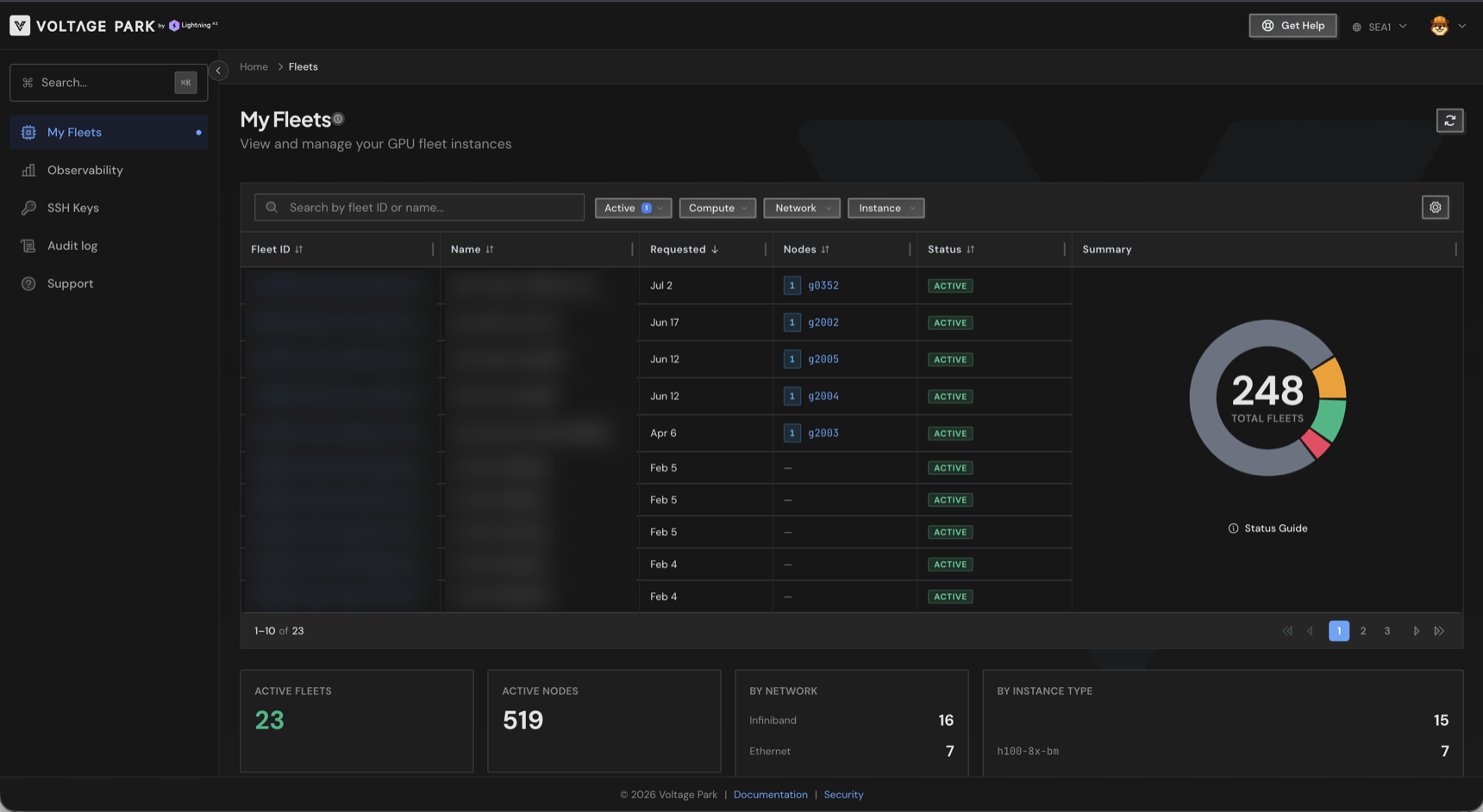
Open cloud.voltagepark.com and select My Fleets. Select a fleet to see its overview, nodes, and monitoring.
API
curl "$API_URL/v1/fleets" -H "Authorization: Bearer $TOKEN"{
"fleets": [
{
"fleetId": "f81d4fae-7dec-11d0-a765-00a0c91e6bf6",
"name": "text-to-video-demo",
"status": "ACTIVE",
"computeType": "BARE_METAL",
"requestedAt": 1755817319000,
"provisionedAt": 1755831319000,
"createdAt": 1755817319000,
"updatedAt": 1755831319000
}
],
"limit": null,
"nextToken": null
}Save the fleet ID:
export FLEET_ID=f81d4fae-7dec-11d0-a765-00a0c91e6bf63. Register your SSH key and apply it to the fleet
Note
Managing SSH keys requires the Administrator role. If you don't have permissions, ask an Administrator to register and apply your key, then skip to step 4.
Register the key against the Linux username you want on the nodes, then apply it to your fleet so its running nodes accept it.
Console
Select SSH Keys in the console, then select Add User. Enter the username and paste your public key.
API
curl -X POST "$API_URL/v1/sshkeys" \
  -H "Authorization: Bearer $TOKEN" \
  -H "Content-Type: application/json" \
  -H "Idempotency-Key: $(uuidgen)" \
  -d "{\"username\": \"jdoe\", \"publicKey\": \"$(cat ~/.ssh/id_ed25519.pub)\", \"description\": \"Work laptop\"}"
Then apply the key to your running fleet. This step uses the API, so you need the token from step 1 and FLEET_ID from step 2. Use the sshKeyId from the registration response. If you registered in the console, list your keys to find it:
curl -X POST "$API_URL/v1/fleets/$FLEET_ID/sshkeys" \
  -H "Authorization: Bearer $TOKEN" \
  -H "Content-Type: application/json" \
  -H "Idempotency-Key: $(uuidgen)" \
  -d '{"sshKeyId": "<sshKeyId>"}'
Keys are written to nodes asynchronously. See SSH keys for details.
4. Connect to a node
List the nodes in the fleet and pick one in the ACTIVE state:
Console
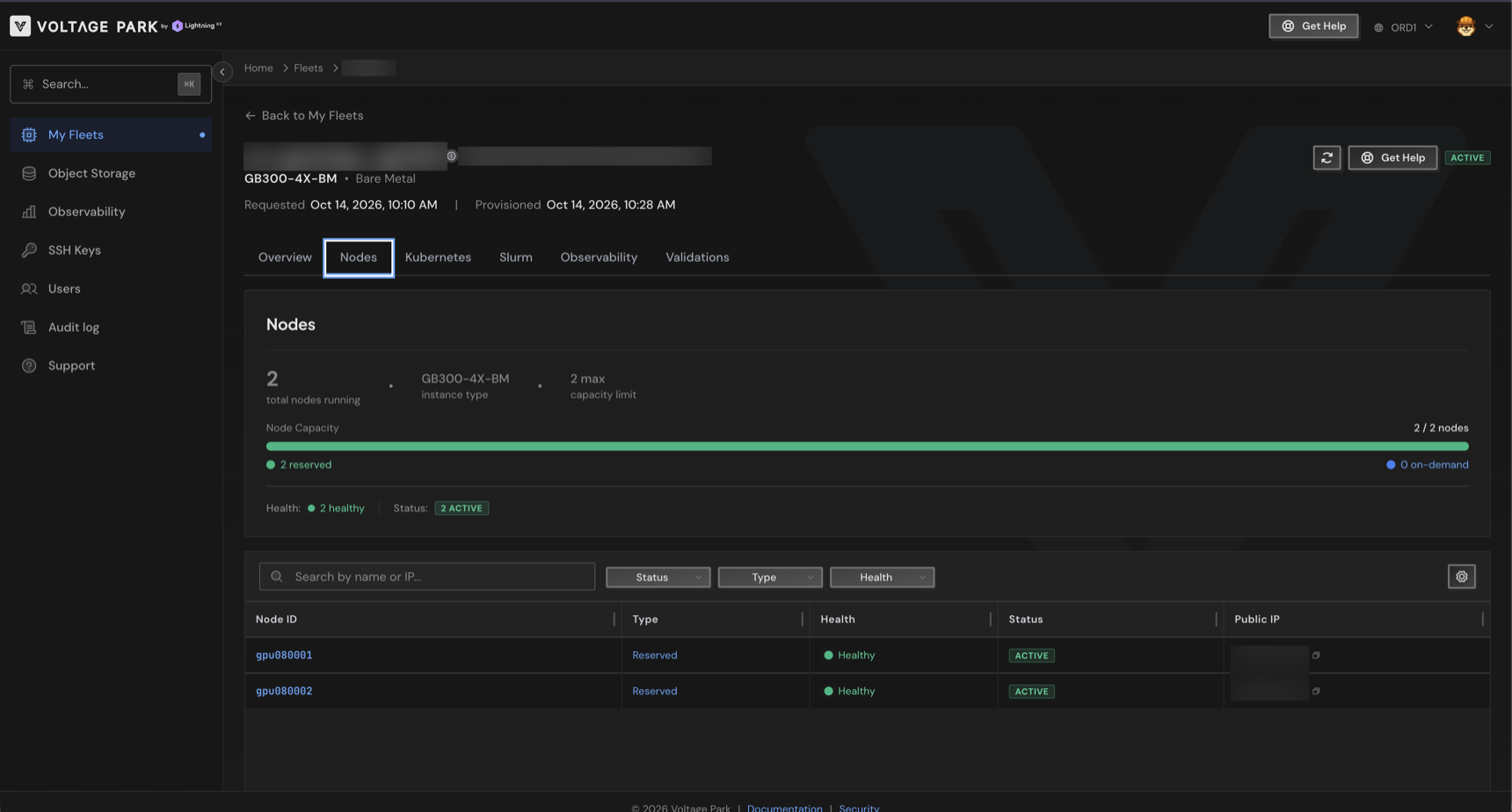
Open your fleet and select the Nodes tab. Each node shows its state and public IP.
API
curl "$API_URL/v1/fleets/$FLEET_ID/nodes" -H "Authorization: Bearer $TOKEN" \
  | jq '.nodes[] | {nodeName, state, publicIp}'
Then connect with the username you registered:
ssh jdoe@<publicIp>
nvidia-smi
5. Fleet's Health
To check the fleet's health, run the following command:
curl "$API_URL/v1/fleets/$FLEET_ID/health" -H "Authorization: Bearer $TOKEN" | jq '.status'In the console, the fleet overview shows the same status. unhealthy means at least one node reported a problem. healthy means no node did, but check node_health for each node's status before assuming every node is ready. See Fleet health.
Next steps
- Core concepts: how organizations, fleets, and nodes fit together.
- Managed Kubernetes: connect
kubectlto a Kubernetes-backed fleet. - Cluster validation: run end-to-end GPU and network tests before your first job.
- Storage views: add or resize shared storage.
- API conventions: pagination, idempotency, and timestamps.
Was this page helpful?
Thanks for the feedback.