
Experiment Tracking with LitLogger
LitLogger is the experiment tracker built into Lightning AI. Instrument your code with metrics, upload media and artifacts, and then visualize these over time inside the Lightning AI platform. LitLogger can be integrated into standalone scripts, or works seamlessly with PyTorch Lightning and Lightning Fabric.
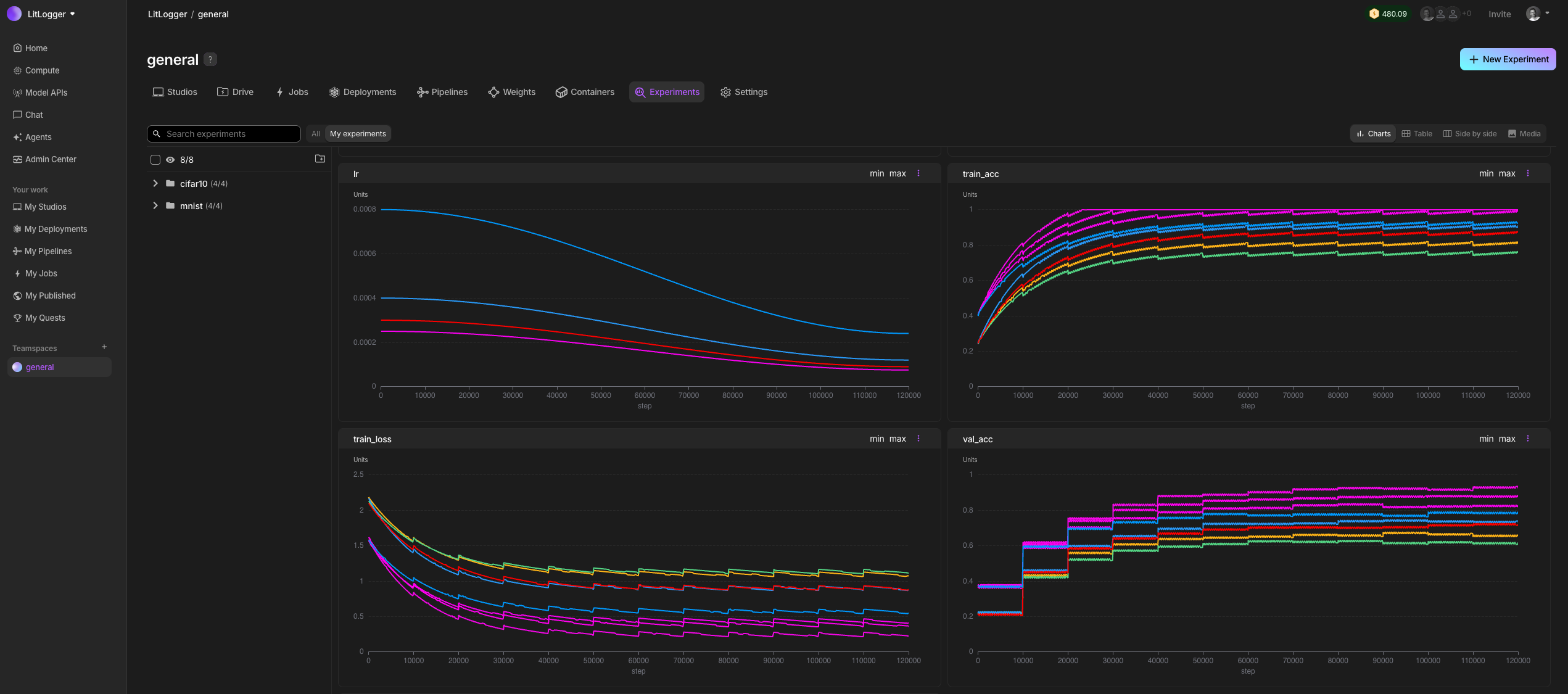
Start Here
Use this path if you are new to LitLogger:
Supported Workflows
LitLogger supports several key workflows:
- Start or resume an
Experimentwithlitlogger.init.init - Log numeric metrics,
ModelorFileartifacts, and media such asImageandText - Integrate seamlessly with PyTorch Lightning or Lightning Fabric using the
lightning:lightning.pytorch.loggers.LitLoggerAPI - Log inference metrics from LitServe
Quick Example
import litlogger
from litlogger import Text, File, Model, Image

# Create or resume an experiment with an optional name
experiment = litlogger.init(name="quickstart")

# Set experiment-level metadata, media, or artifacts
experiment["model_name"] = "resnet50"
# experiment["model"] = Model(<filepath or object>)
# experiment["config"] = File(<filepath>)

# Use append to log metrics or media at each step or epoch
global_step = 0
for epoch in range(5):
    for step in range(10):
        experiment["epoch"].append(epoch, step=global_step)
        experiment["train/loss"].append(1.0 / (global_step + 1), step=global_step)
        global_step += 1

    # experiment["validation_image"].append(Image(<filepath or object>), step=global_step)

experiment["summary"] = Text(f"Completed {global_step} steps across {epoch} epochs")

# Manually mark the experiment as complete
experiment.finalize()
Documentation Map
Tutorials provide end-to-end, task-oriented walkthroughs.
Guides explain workflows, migration paths, and logging patterns in more depth.
Examples include every runnable example currently shipped in the repository.
The API reference documents the public classes, functions, and enums.
Start
Tutorials
Guides
Examples
See Examples for the full list of runnable repository examples.
API Reference
Was this page helpful?
Thanks for the feedback.