
F-1 Score
Module Interface
- class torchmetrics.F1Score(**kwargs)[source]
Compute F-1 score.
The metric is only proper defined when where , and represent the number of true positives, false positives and false negatives respectively. If this case is encountered for any class/label, the metric for that class/label will be set to zero_division (0 or 1, default is 0) and the overall metric may therefore be affected in turn.
This function is a simple wrapper to get the task specific versions of this metric, which is done by setting the
taskargument to either'binary','multiclass'or'multilabel'. See the documentation ofBinaryF1Score,MulticlassF1ScoreandMultilabelF1Scorefor the specific details of each argument influence and examples.- Legacy Example:
>>> from torch import tensor
>>> target = tensor([0, 1, 2, 0, 1, 2])
>>> preds = tensor([0, 2, 1, 0, 0, 1])
>>> f1 = F1Score(task="multiclass", num_classes=3)
>>> f1(preds, target)
tensor(0.3333)
BinaryF1Score
- class torchmetrics.classification.BinaryF1Score(threshold=0.5, multidim_average='global', ignore_index=None, validate_args=True, zero_division=0, **kwargs)[source]
Compute F-1 score for binary tasks.
The metric is only proper defined when where , and represent the number of true positives, false positives and false negatives respectively. If this case is encountered a score of zero_division (0 or 1, default is 0) is returned.
As input to
forwardandupdatethe metric accepts the following input:preds(Tensor): An int or float tensor of shape(N, ...). If preds is a floating point tensor with values outside [0,1] range we consider the input to be logits and will auto apply sigmoid per element. Additionally, we convert to int tensor with thresholding using the value inthreshold.target(Tensor): An int tensor of shape(N, ...)
As output to
forwardandcomputethe metric returns the following output:bf1s(Tensor): A tensor whose returned shape depends on themultidim_averageargument:If
multidim_averageis set toglobal, the metric returns a scalar value.If
multidim_averageis set tosamplewise, the metric returns(N,)vector consisting of a scalar value per sample.
If
multidim_averageis set tosamplewisewe expect at least one additional dimension...to be present, which the reduction will then be applied over instead of the sample dimensionN.- Parameters:
threshold (
float) – Threshold for transforming probability to binary {0,1} predictionsmultidim_average (
Literal['global','samplewise']) –Defines how additionally dimensions
...should be handled. Should be one of the following:global: Additional dimensions are flatted along the batch dimensionsamplewise: Statistic will be calculated independently for each sample on theNaxis. The statistics in this case are calculated over the additional dimensions.
ignore_index (
Optional[int]) – Specifies a target value that is ignored and does not contribute to the metric calculationvalidate_args (
bool) – bool indicating if input arguments and tensors should be validated for correctness. Set toFalsefor faster computations.zero_division (
float) – Should be 0 or 1. The value returned when .
- Example (preds is int tensor):
>>> from torch import tensor >>> from torchmetrics.classification import BinaryF1Score >>> target = tensor([0, 1, 0, 1, 0, 1]) >>> preds = tensor([0, 0, 1, 1, 0, 1]) >>> metric = BinaryF1Score() >>> metric(preds, target) tensor(0.6667)- Example (preds is float tensor):
>>> from torchmetrics.classification import BinaryF1Score >>> target = tensor([0, 1, 0, 1, 0, 1]) >>> preds = tensor([0.11, 0.22, 0.84, 0.73, 0.33, 0.92]) >>> metric = BinaryF1Score() >>> metric(preds, target) tensor(0.6667)- Example (multidim tensors):
>>> from torchmetrics.classification import BinaryF1Score
>>> target = tensor([[[0, 1], [1, 0], [0, 1]], [[1, 1], [0, 0], [1, 0]]])
>>> preds = tensor([[[0.59, 0.91], [0.91, 0.99],  [0.63, 0.04]],
...                 [[0.38, 0.04], [0.86, 0.780], [0.45, 0.37]]])
>>> metric = BinaryF1Score(multidim_average='samplewise')
>>> metric(preds, target)
tensor([0.5000, 0.0000])
- plot(val=None, ax=None)[source]
Plot a single or multiple values from the metric.
- Parameters:
val (
Union[Tensor,Sequence[Tensor],None]) – Either a single result from calling metric.forward or metric.compute or a list of these results. If no value is provided, will automatically call metric.compute and plot that result.ax (
Optional[Axes]) – An matplotlib axis object. If provided will add plot to that axis
- Return type:
- Returns:
Figure object and Axes object
- Raises:
ModuleNotFoundError – If matplotlib is not installed
>>> from torch import rand, randint
>>> # Example plotting a single value
>>> from torchmetrics.classification import BinaryF1Score
>>> metric = BinaryF1Score()
>>> metric.update(rand(10), randint(2,(10,)))
>>> fig_, ax_ = metric.plot()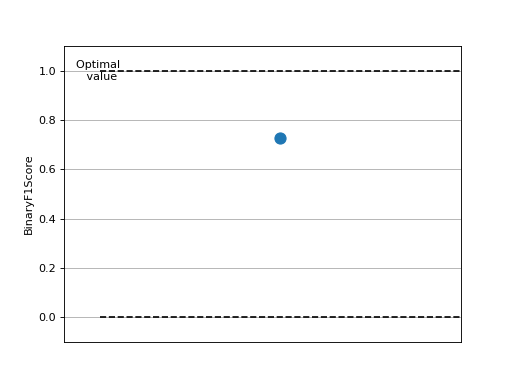
>>> from torch import rand, randint
>>> # Example plotting multiple values
>>> from torchmetrics.classification import BinaryF1Score
>>> metric = BinaryF1Score()
>>> values = [ ]
>>> for _ in range(10):
...     values.append(metric(rand(10), randint(2,(10,))))
>>> fig_, ax_ = metric.plot(values)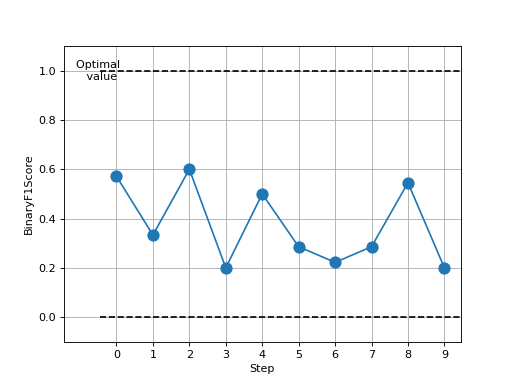
MulticlassF1Score
- class torchmetrics.classification.MulticlassF1Score(num_classes, top_k=1, average='macro', multidim_average='global', ignore_index=None, validate_args=True, zero_division=0, **kwargs)[source]
Compute F-1 score for multiclass tasks.
The metric is only proper defined when where , and represent the number of true positives, false positives and false negatives respectively. If this case is encountered for any class, the metric for that class will be set to zero_division (0 or 1, default is 0) and the overall metric may therefore be affected in turn.
As input to
forwardandupdatethe metric accepts the following input:preds(Tensor): An int tensor of shape(N, ...)or float tensor of shape(N, C, ..). If preds is a floating point we applytorch.argmaxalong theCdimension to automatically convert probabilities/logits into an int tensor.target(Tensor): An int tensor of shape(N, ...)
As output to
forwardandcomputethe metric returns the following output:mcf1s(Tensor): A tensor whose returned shape depends on theaverageandmultidim_averagearguments:If
multidim_averageis set toglobal:If
average='micro'/'macro'/'weighted', the output will be a scalar tensorIf
average=None/'none', the shape will be(C,)
If
multidim_averageis set tosamplewise:If
average='micro'/'macro'/'weighted', the shape will be(N,)If
average=None/'none', the shape will be(N, C)
If
multidim_averageis set tosamplewisewe expect at least one additional dimension...to be present, which the reduction will then be applied over instead of the sample dimensionN.- Parameters:
preds – Tensor with predictions
target – Tensor with true labels
num_classes (
int) – Integer specifying the number of classesaverage (
Optional[Literal['micro','macro','weighted','none']]) –Defines the reduction that is applied over labels. Should be one of the following:
micro: Sum statistics over all labelsmacro: Calculate statistics for each label and average themweighted: calculates statistics for each label and computes weighted average using their support"none"orNone: calculates statistic for each label and applies no reduction
top_k (
int) – Number of highest probability or logit score predictions considered to find the correct label. Only works whenpredscontain probabilities/logits.multidim_average (
Literal['global','samplewise']) –Defines how additionally dimensions
...should be handled. Should be one of the following:global: Additional dimensions are flatted along the batch dimensionsamplewise: Statistic will be calculated independently for each sample on theNaxis. The statistics in this case are calculated over the additional dimensions.
ignore_index (
Optional[int]) – Specifies a target value that is ignored and does not contribute to the metric calculationvalidate_args (
bool) – bool indicating if input arguments and tensors should be validated for correctness. Set toFalsefor faster computations.zero_division (
float) – Should be 0 or 1. The value returned when .
- Example (preds is int tensor):
>>> from torch import tensor >>> from torchmetrics.classification import MulticlassF1Score >>> target = tensor([2, 1, 0, 0]) >>> preds = tensor([2, 1, 0, 1]) >>> metric = MulticlassF1Score(num_classes=3) >>> metric(preds, target) tensor(0.7778) >>> mcf1s = MulticlassF1Score(num_classes=3, average=None) >>> mcf1s(preds, target) tensor([0.6667, 0.6667, 1.0000])- Example (preds is float tensor):
>>> from torchmetrics.classification import MulticlassF1Score >>> target = tensor([2, 1, 0, 0]) >>> preds = tensor([[0.16, 0.26, 0.58], ... [0.22, 0.61, 0.17], ... [0.71, 0.09, 0.20], ... [0.05, 0.82, 0.13]]) >>> metric = MulticlassF1Score(num_classes=3) >>> metric(preds, target) tensor(0.7778) >>> mcf1s = MulticlassF1Score(num_classes=3, average=None) >>> mcf1s(preds, target) tensor([0.6667, 0.6667, 1.0000])- Example (multidim tensors):
>>> from torchmetrics.classification import MulticlassF1Score
>>> target = tensor([[[0, 1], [2, 1], [0, 2]], [[1, 1], [2, 0], [1, 2]]])
>>> preds = tensor([[[0, 2], [2, 0], [0, 1]], [[2, 2], [2, 1], [1, 0]]])
>>> metric = MulticlassF1Score(num_classes=3, multidim_average='samplewise')
>>> metric(preds, target)
tensor([0.4333, 0.2667])
>>> mcf1s = MulticlassF1Score(num_classes=3, multidim_average='samplewise', average=None)
>>> mcf1s(preds, target)
tensor([[0.8000, 0.0000, 0.5000],
        [0.0000, 0.4000, 0.4000]])
- plot(val=None, ax=None)[source]
Plot a single or multiple values from the metric.
- Parameters:
val (
Union[Tensor,Sequence[Tensor],None]) – Either a single result from calling metric.forward or metric.compute or a list of these results. If no value is provided, will automatically call metric.compute and plot that result.ax (
Optional[Axes]) – An matplotlib axis object. If provided will add plot to that axis
- Return type:
- Returns:
Figure object and Axes object
- Raises:
ModuleNotFoundError – If matplotlib is not installed
>>> from torch import randint
>>> # Example plotting a single value per class
>>> from torchmetrics.classification import MulticlassF1Score
>>> metric = MulticlassF1Score(num_classes=3, average=None)
>>> metric.update(randint(3, (20,)), randint(3, (20,)))
>>> fig_, ax_ = metric.plot()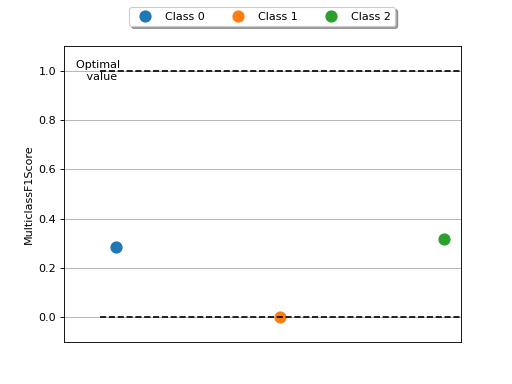
>>> from torch import randint
>>> # Example plotting a multiple values per class
>>> from torchmetrics.classification import MulticlassF1Score
>>> metric = MulticlassF1Score(num_classes=3, average=None)
>>> values = []
>>> for _ in range(20):
...     values.append(metric(randint(3, (20,)), randint(3, (20,))))
>>> fig_, ax_ = metric.plot(values)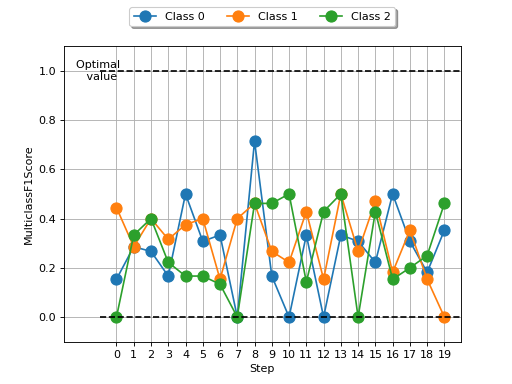
MultilabelF1Score
- class torchmetrics.classification.MultilabelF1Score(num_labels, threshold=0.5, average='macro', multidim_average='global', ignore_index=None, validate_args=True, zero_division=0, **kwargs)[source]
Compute F-1 score for multilabel tasks.
The metric is only proper defined when where , and represent the number of true positives, false positives and false negatives respectively. If this case is encountered for any label, the metric for that label will be set to zero_division (0 or 1, default is 0) and the overall metric may therefore be affected in turn.
As input to
forwardandupdatethe metric accepts the following input:preds(Tensor): An int or float tensor of shape(N, C, ...). If preds is a floating point tensor with values outside [0,1] range we consider the input to be logits and will auto apply sigmoid per element. Additionally, we convert to int tensor with thresholding using the value inthreshold.target(Tensor): An int tensor of shape(N, C, ...).
As output to
forwardandcomputethe metric returns the following output:mlf1s(Tensor): A tensor whose returned shape depends on theaverageandmultidim_averagearguments:If
multidim_averageis set toglobal:If
average='micro'/'macro'/'weighted', the output will be a scalar tensorIf
average=None/'none', the shape will be(C,)
If
multidim_averageis set tosamplewise:If
average='micro'/'macro'/'weighted', the shape will be(N,)If
average=None/'none', the shape will be(N, C)`
If
multidim_averageis set tosamplewisewe expect at least one additional dimension...to be present, which the reduction will then be applied over instead of the sample dimensionN.- Parameters:
num_labels (
int) – Integer specifying the number of labelsthreshold (
float) – Threshold for transforming probability to binary (0,1) predictionsaverage (
Optional[Literal['micro','macro','weighted','none']]) –Defines the reduction that is applied over labels. Should be one of the following:
micro: Sum statistics over all labelsmacro: Calculate statistics for each label and average themweighted: calculates statistics for each label and computes weighted average using their support"none"orNone: calculates statistic for each label and applies no reduction
multidim_average (
Literal['global','samplewise']) –Defines how additionally dimensions
...should be handled. Should be one of the following:global: Additional dimensions are flatted along the batch dimensionsamplewise: Statistic will be calculated independently for each sample on theNaxis. The statistics in this case are calculated over the additional dimensions.
ignore_index (
Optional[int]) – Specifies a target value that is ignored and does not contribute to the metric calculationvalidate_args (
bool) – bool indicating if input arguments and tensors should be validated for correctness. Set toFalsefor faster computations.zero_division (
float) – Should be 0 or 1. The value returned when .
- Example (preds is int tensor):
>>> from torch import tensor >>> from torchmetrics.classification import MultilabelF1Score >>> target = tensor([[0, 1, 0], [1, 0, 1]]) >>> preds = tensor([[0, 0, 1], [1, 0, 1]]) >>> metric = MultilabelF1Score(num_labels=3) >>> metric(preds, target) tensor(0.5556) >>> mlf1s = MultilabelF1Score(num_labels=3, average=None) >>> mlf1s(preds, target) tensor([1.0000, 0.0000, 0.6667])- Example (preds is float tensor):
>>> from torchmetrics.classification import MultilabelF1Score >>> target = tensor([[0, 1, 0], [1, 0, 1]]) >>> preds = tensor([[0.11, 0.22, 0.84], [0.73, 0.33, 0.92]]) >>> metric = MultilabelF1Score(num_labels=3) >>> metric(preds, target) tensor(0.5556) >>> mlf1s = MultilabelF1Score(num_labels=3, average=None) >>> mlf1s(preds, target) tensor([1.0000, 0.0000, 0.6667])- Example (multidim tensors):
>>> from torchmetrics.classification import MultilabelF1Score
>>> target = tensor([[[0, 1], [1, 0], [0, 1]], [[1, 1], [0, 0], [1, 0]]])
>>> preds = tensor([[[0.59, 0.91], [0.91, 0.99],  [0.63, 0.04]],
...                 [[0.38, 0.04], [0.86, 0.780], [0.45, 0.37]]])
>>> metric = MultilabelF1Score(num_labels=3, multidim_average='samplewise')
>>> metric(preds, target)
tensor([0.4444, 0.0000])
>>> mlf1s = MultilabelF1Score(num_labels=3, multidim_average='samplewise', average=None)
>>> mlf1s(preds, target)
tensor([[0.6667, 0.6667, 0.0000],
        [0.0000, 0.0000, 0.0000]])
- plot(val=None, ax=None)[source]
Plot a single or multiple values from the metric.
- Parameters:
val (
Union[Tensor,Sequence[Tensor],None]) – Either a single result from calling metric.forward or metric.compute or a list of these results. If no value is provided, will automatically call metric.compute and plot that result.ax (
Optional[Axes]) – An matplotlib axis object. If provided will add plot to that axis
- Return type:
- Returns:
Figure and Axes object
- Raises:
ModuleNotFoundError – If matplotlib is not installed
>>> from torch import rand, randint
>>> # Example plotting a single value
>>> from torchmetrics.classification import MultilabelF1Score
>>> metric = MultilabelF1Score(num_labels=3)
>>> metric.update(randint(2, (20, 3)), randint(2, (20, 3)))
>>> fig_, ax_ = metric.plot()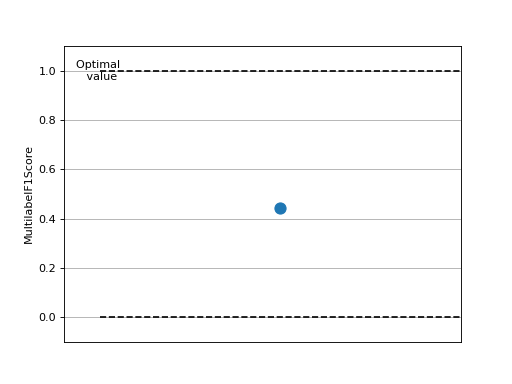
>>> from torch import rand, randint
>>> # Example plotting multiple values
>>> from torchmetrics.classification import MultilabelF1Score
>>> metric = MultilabelF1Score(num_labels=3)
>>> values = [ ]
>>> for _ in range(10):
...     values.append(metric(randint(2, (20, 3)), randint(2, (20, 3))))
>>> fig_, ax_ = metric.plot(values)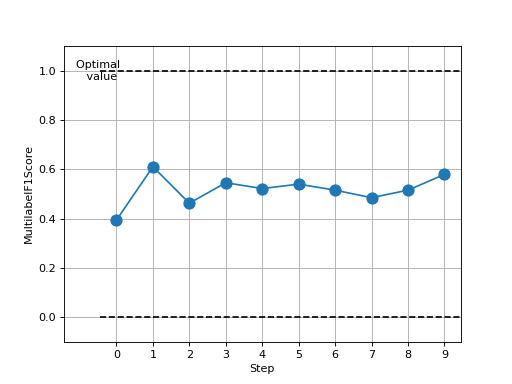
Functional Interface
f1_score
- torchmetrics.functional.f1_score(preds, target, task, threshold=0.5, num_classes=None, num_labels=None, average='micro', multidim_average='global', top_k=1, ignore_index=None, validate_args=True, zero_division=0)[source]
Compute F-1 score. :rtype:
TensorThis function is a simple wrapper to get the task specific versions of this metric, which is done by setting the
taskargument to either'binary','multiclass'or'multilabel'. See the documentation ofbinary_f1_score(),multiclass_f1_score()andmultilabel_f1_score()for the specific details of each argument influence and examples.- Legacy Example:
>>> from torch import tensor
>>> target = tensor([0, 1, 2, 0, 1, 2])
>>> preds = tensor([0, 2, 1, 0, 0, 1])
>>> f1_score(preds, target, task="multiclass", num_classes=3)
tensor(0.3333)
binary_f1_score
- torchmetrics.functional.classification.binary_f1_score(preds, target, threshold=0.5, multidim_average='global', ignore_index=None, validate_args=True, zero_division=0)[source]
Compute F-1 score for binary tasks.
Accepts the following input tensors:
preds(int or float tensor):(N, ...). If preds is a floating point tensor with values outside [0,1] range we consider the input to be logits and will auto apply sigmoid per element. Additionally, we convert to int tensor with thresholding using the value inthreshold.target(int tensor):(N, ...)
- Parameters:
preds (
Tensor) – Tensor with predictionstarget (
Tensor) – Tensor with true labelsthreshold (
float) – Threshold for transforming probability to binary {0,1} predictionsmultidim_average (
Literal['global','samplewise']) –Defines how additionally dimensions
...should be handled. Should be one of the following:global: Additional dimensions are flatted along the batch dimensionsamplewise: Statistic will be calculated independently for each sample on theNaxis. The statistics in this case are calculated over the additional dimensions.
ignore_index (
Optional[int]) – Specifies a target value that is ignored and does not contribute to the metric calculationvalidate_args (
bool) – bool indicating if input arguments and tensors should be validated for correctness. Set toFalsefor faster computations.zero_division (
float) – Should be 0 or 1. The value returned when .
- Return type:
- Returns:
If
multidim_averageis set toglobal, the metric returns a scalar value. Ifmultidim_averageis set tosamplewise, the metric returns(N,)vector consisting of a scalar value per sample.
- Example (preds is int tensor):
>>> from torch import tensor >>> from torchmetrics.functional.classification import binary_f1_score >>> target = tensor([0, 1, 0, 1, 0, 1]) >>> preds = tensor([0, 0, 1, 1, 0, 1]) >>> binary_f1_score(preds, target) tensor(0.6667)- Example (preds is float tensor):
>>> from torchmetrics.functional.classification import binary_f1_score >>> target = tensor([0, 1, 0, 1, 0, 1]) >>> preds = tensor([0.11, 0.22, 0.84, 0.73, 0.33, 0.92]) >>> binary_f1_score(preds, target) tensor(0.6667)- Example (multidim tensors):
>>> from torchmetrics.functional.classification import binary_f1_score
>>> target = tensor([[[0, 1], [1, 0], [0, 1]], [[1, 1], [0, 0], [1, 0]]])
>>> preds = tensor([[[0.59, 0.91], [0.91, 0.99], [0.63, 0.04]],
...                 [[0.38, 0.04], [0.86, 0.780], [0.45, 0.37]]])
>>> binary_f1_score(preds, target, multidim_average='samplewise')
tensor([0.5000, 0.0000])
multiclass_f1_score
- torchmetrics.functional.classification.multiclass_f1_score(preds, target, num_classes, average='macro', top_k=1, multidim_average='global', ignore_index=None, validate_args=True, zero_division=0)[source]
Compute F-1 score for multiclass tasks.
Accepts the following input tensors:
preds:(N, ...)(int tensor) or(N, C, ..)(float tensor). If preds is a floating point we applytorch.argmaxalong theCdimension to automatically convert probabilities/logits into an int tensor.target(int tensor):(N, ...)
- Parameters:
preds (
Tensor) – Tensor with predictionstarget (
Tensor) – Tensor with true labelsnum_classes (
int) – Integer specifying the number of classesaverage (
Optional[Literal['micro','macro','weighted','none']]) –Defines the reduction that is applied over labels. Should be one of the following:
micro: Sum statistics over all labelsmacro: Calculate statistics for each label and average themweighted: calculates statistics for each label and computes weighted average using their support"none"orNone: calculates statistic for each label and applies no reduction
top_k (
int) – Number of highest probability or logit score predictions considered to find the correct label. Only works whenpredscontain probabilities/logits.multidim_average (
Literal['global','samplewise']) –Defines how additionally dimensions
...should be handled. Should be one of the following:global: Additional dimensions are flatted along the batch dimensionsamplewise: Statistic will be calculated independently for each sample on theNaxis. The statistics in this case are calculated over the additional dimensions.
ignore_index (
Optional[int]) – Specifies a target value that is ignored and does not contribute to the metric calculationvalidate_args (
bool) – bool indicating if input arguments and tensors should be validated for correctness. Set toFalsefor faster computations.zero_division (
float) – Should be 0 or 1. The value returned when .
- Returns:
If
multidim_averageis set toglobal:If
average='micro'/'macro'/'weighted', the output will be a scalar tensorIf
average=None/'none', the shape will be(C,)
If
multidim_averageis set tosamplewise:If
average='micro'/'macro'/'weighted', the shape will be(N,)If
average=None/'none', the shape will be(N, C)
- Return type:
The returned shape depends on the
averageandmultidim_averagearguments
- Example (preds is int tensor):
>>> from torch import tensor >>> from torchmetrics.functional.classification import multiclass_f1_score >>> target = tensor([2, 1, 0, 0]) >>> preds = tensor([2, 1, 0, 1]) >>> multiclass_f1_score(preds, target, num_classes=3) tensor(0.7778) >>> multiclass_f1_score(preds, target, num_classes=3, average=None) tensor([0.6667, 0.6667, 1.0000])- Example (preds is float tensor):
>>> from torchmetrics.functional.classification import multiclass_f1_score >>> target = tensor([2, 1, 0, 0]) >>> preds = tensor([[0.16, 0.26, 0.58], ... [0.22, 0.61, 0.17], ... [0.71, 0.09, 0.20], ... [0.05, 0.82, 0.13]]) >>> multiclass_f1_score(preds, target, num_classes=3) tensor(0.7778) >>> multiclass_f1_score(preds, target, num_classes=3, average=None) tensor([0.6667, 0.6667, 1.0000])- Example (multidim tensors):
>>> from torchmetrics.functional.classification import multiclass_f1_score
>>> target = tensor([[[0, 1], [2, 1], [0, 2]], [[1, 1], [2, 0], [1, 2]]])
>>> preds = tensor([[[0, 2], [2, 0], [0, 1]], [[2, 2], [2, 1], [1, 0]]])
>>> multiclass_f1_score(preds, target, num_classes=3, multidim_average='samplewise')
tensor([0.4333, 0.2667])
>>> multiclass_f1_score(preds, target, num_classes=3, multidim_average='samplewise', average=None)
tensor([[0.8000, 0.0000, 0.5000],
        [0.0000, 0.4000, 0.4000]])
multilabel_f1_score
- torchmetrics.functional.classification.multilabel_f1_score(preds, target, num_labels, threshold=0.5, average='macro', multidim_average='global', ignore_index=None, validate_args=True, zero_division=0)[source]
Compute F-1 score for multilabel tasks.
Accepts the following input tensors:
preds(int or float tensor):(N, C, ...). If preds is a floating point tensor with values outside [0,1] range we consider the input to be logits and will auto apply sigmoid per element. Additionally, we convert to int tensor with thresholding using the value inthreshold.target(int tensor):(N, C, ...)
- Parameters:
preds (
Tensor) – Tensor with predictionstarget (
Tensor) – Tensor with true labelsnum_labels (
int) – Integer specifying the number of labelsthreshold (
float) – Threshold for transforming probability to binary (0,1) predictionsaverage (
Optional[Literal['micro','macro','weighted','none']]) –Defines the reduction that is applied over labels. Should be one of the following:
micro: Sum statistics over all labelsmacro: Calculate statistics for each label and average themweighted: calculates statistics for each label and computes weighted average using their support"none"orNone: calculates statistic for each label and applies no reduction
multidim_average (
Literal['global','samplewise']) –Defines how additionally dimensions
...should be handled. Should be one of the following:global: Additional dimensions are flatted along the batch dimensionsamplewise: Statistic will be calculated independently for each sample on theNaxis. The statistics in this case are calculated over the additional dimensions.
ignore_index (
Optional[int]) – Specifies a target value that is ignored and does not contribute to the metric calculationvalidate_args (
bool) – bool indicating if input arguments and tensors should be validated for correctness. Set toFalsefor faster computations.zero_division (
float) – Should be 0 or 1. The value returned when .
- Returns:
If
multidim_averageis set toglobal:If
average='micro'/'macro'/'weighted', the output will be a scalar tensorIf
average=None/'none', the shape will be(C,)
If
multidim_averageis set tosamplewise:If
average='micro'/'macro'/'weighted', the shape will be(N,)If
average=None/'none', the shape will be(N, C)
- Return type:
The returned shape depends on the
averageandmultidim_averagearguments
- Example (preds is int tensor):
>>> from torch import tensor >>> from torchmetrics.functional.classification import multilabel_f1_score >>> target = tensor([[0, 1, 0], [1, 0, 1]]) >>> preds = tensor([[0, 0, 1], [1, 0, 1]]) >>> multilabel_f1_score(preds, target, num_labels=3) tensor(0.5556) >>> multilabel_f1_score(preds, target, num_labels=3, average=None) tensor([1.0000, 0.0000, 0.6667])- Example (preds is float tensor):
>>> from torchmetrics.functional.classification import multilabel_f1_score >>> target = tensor([[0, 1, 0], [1, 0, 1]]) >>> preds = tensor([[0.11, 0.22, 0.84], [0.73, 0.33, 0.92]]) >>> multilabel_f1_score(preds, target, num_labels=3) tensor(0.5556) >>> multilabel_f1_score(preds, target, num_labels=3, average=None) tensor([1.0000, 0.0000, 0.6667])- Example (multidim tensors):
>>> from torchmetrics.functional.classification import multilabel_f1_score
>>> target = tensor([[[0, 1], [1, 0], [0, 1]], [[1, 1], [0, 0], [1, 0]]])
>>> preds = tensor([[[0.59, 0.91], [0.91, 0.99], [0.63, 0.04]],
...                 [[0.38, 0.04], [0.86, 0.780], [0.45, 0.37]]])
>>> multilabel_f1_score(preds, target, num_labels=3, multidim_average='samplewise')
tensor([0.4444, 0.0000])
>>> multilabel_f1_score(preds, target, num_labels=3, multidim_average='samplewise', average=None)
tensor([[0.6667, 0.6667, 0.0000],
        [0.0000, 0.0000, 0.0000]])
Was this page helpful?
Thanks for the feedback.