
Fast work, small team
Slalom isn’t just a global consulting firm that helps companies build and deploy data platforms, machine learning models, and AI-driven applications. Internally, they also run experimental teams to explore new ways data can drive better decisions. One of those teams, the Executive Data Team, set out to build a forecasting system to help predict if, and when, new business opportunities would be won.
At the time, the team was small. Michael Pilosov, a machine learning platform engineer, was the only full-time member on this team. The rest were part-time contributors. But the questions they wanted to answer required unprecedented scale for them: could they build predictive models that were backtested (evaluated) against years of sales data, and easily launch experiments to improve performance?
“It wasn’t just about building a model,” said Michael. “It was about being able to ask, how confident are we, and should we trust this prediction? That meant testing across time and across scenarios.” Business context informs modeling hypothesis, so “it needed to be easy to test theories about how many sub-models should be aggregated into the final prediction.”
Infrastructure without the headcount
To answer those questions, they needed to scale fast. Backtesting and forecasting at this level meant going from dozens to hundreds of machines, running repeated experiments, and managing pipelines over time.
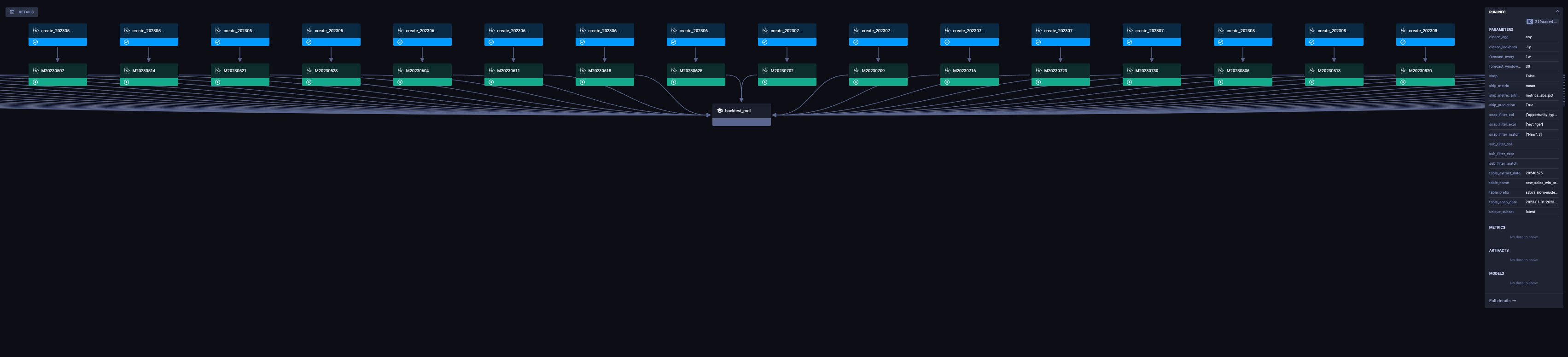
Without a dedicated infrastructure team for this effort, and only one full-time engineer, they needed a way to stay focused on the work, not the provisioning of compute. “There’s no world where I could’ve orchestrated the necessary resources that quickly without Lightning,” Michael said. “We had to scale compute massively, but we couldn’t afford to spend months figuring out how to wire everything. I wanted to focus on designing the platform and unblocking hypothesis testing, not writing infrastructure-as-code for relatively short-term computational needs.”
Scaled compute, no setup overhead
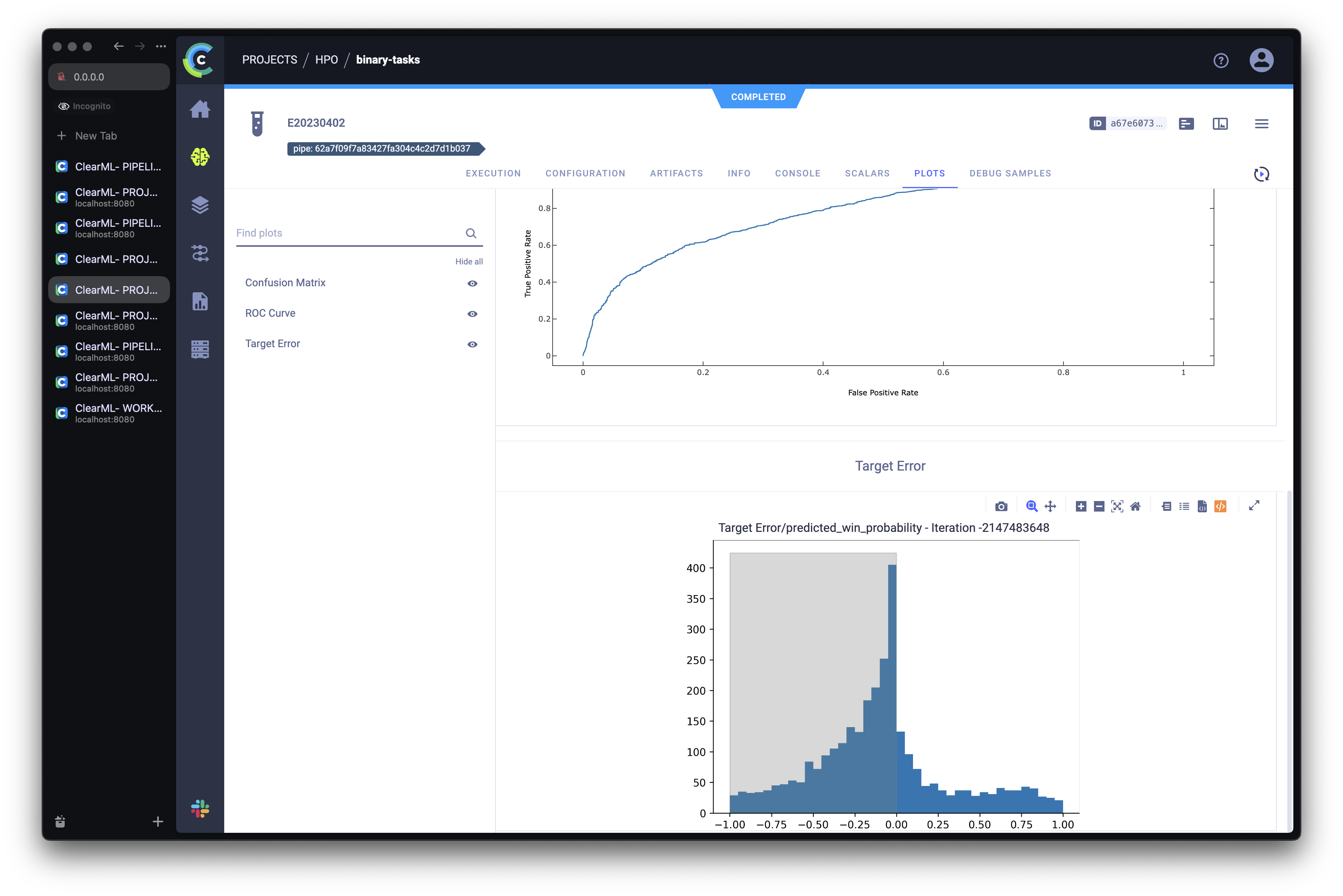
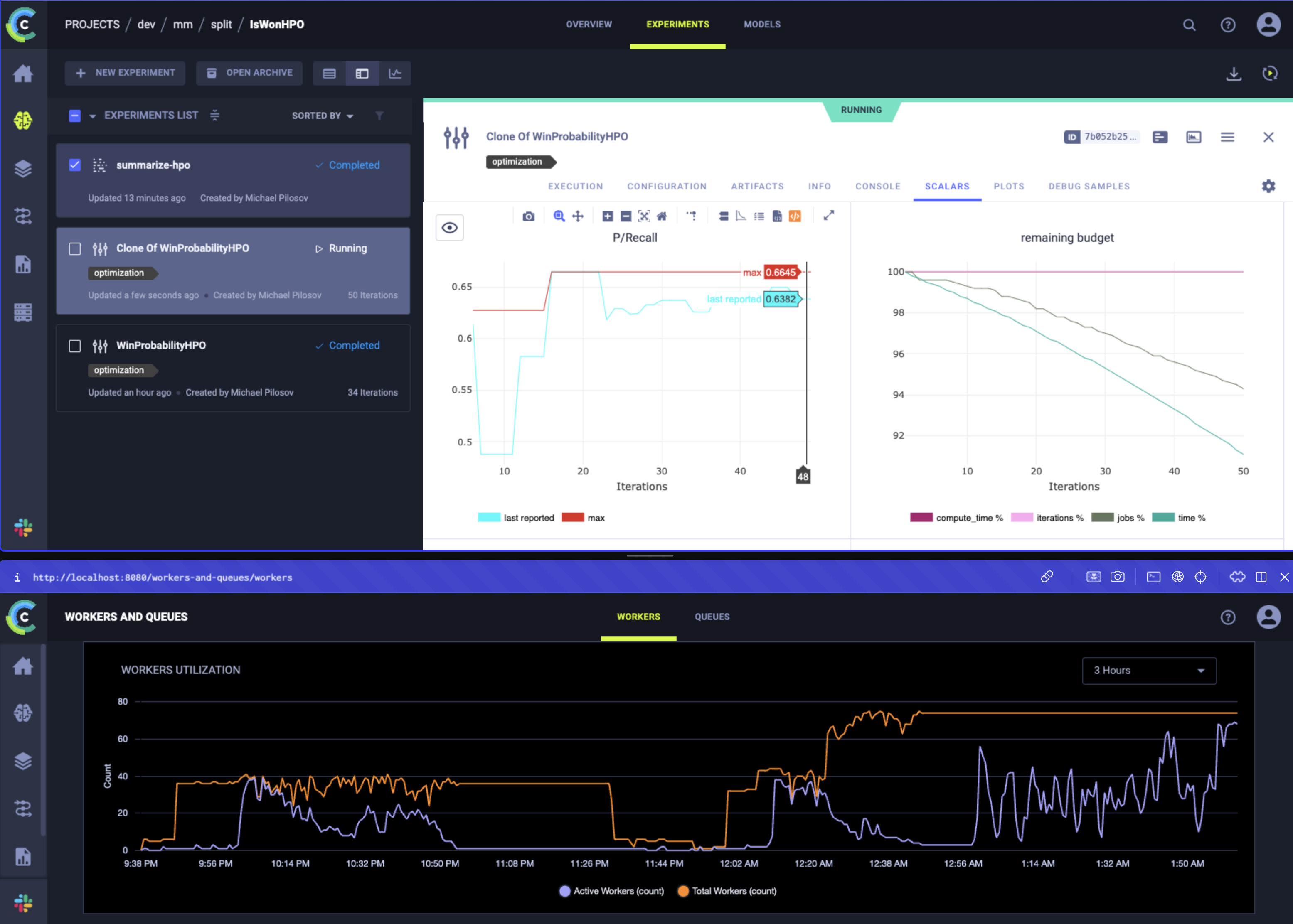
Michael deployed the entire stack using Lightning AI, setting up studios that ran in a sandboxed AWS environment with minimal manual configuration. The team used ClearML for experiment tracking and kept everything centralized in Lightning for training, evaluation, and development iteration. “We were probably the first to run self-hosted ClearML in Lightning Studios, and developed a lot of expertise in how to configure it for cost-efficiency and scale.”
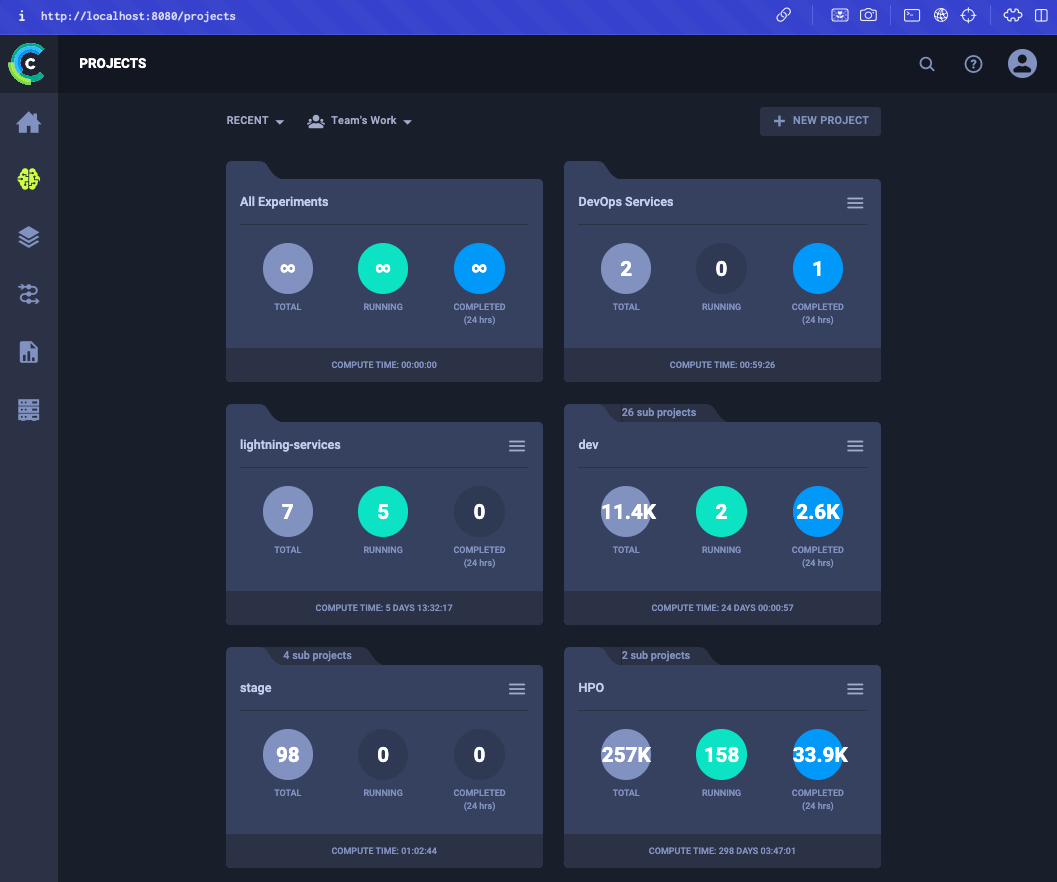
It let them move fast. They could experiment, retrain, and push new versions of the model back into production. Once they validated the best-performing version, it was packaged and deployed to a daily inference pipeline. Six months later, that model is still running daily predictions that are surfaced in Salesforce.
“When priorities shifted and people moved off the project, we knew we could always come back to it,” said Michael. “Turn the Studio(s) back on, rerun an experiment, and retrain on the latest data. The system just sits there ready to recreate the computational resources when we are.”
From half a day to two hours
Lightning helped the team bypass months of infrastructure work. Instead of writing custom setup scripts or provisioning dozens of EC2s manually, they could get straight to testing hypotheses.
Michael estimates Lightning saved them 2–3 months of infrastructure setup time, and possibly more in reduced mental overhead for ongoing maintenance. More importantly, it helped them deliver business value with battle-tested forecasts, simplified reporting, and automated workflows, without needing a full MLOps team.
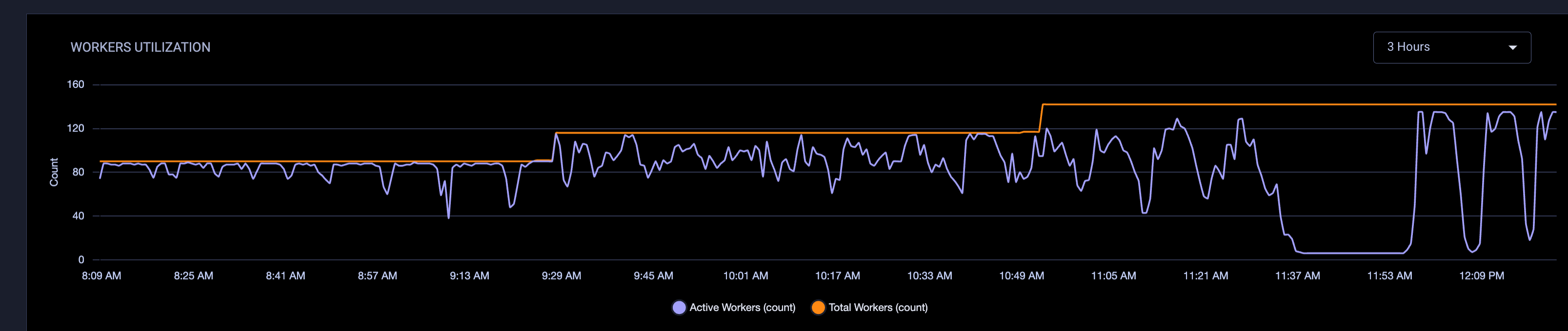
Lightning continues to be part of their daily workflow. “It saves us time every week,” Michael said. What used to take most of a day–resolving access issues, installing tools, setting up environments–now takes at most two hours. Team members can engage directly with their tasks, collaborating without frustration. More importantly, the process became reliable and repeatable. New engineers on the project didn’t need walkthroughs or one-on-one help to get started. Everything they needed was already there. “Once a Studio for a new type of task is created, anyone else can use it as a foundation for their experiments without me intervening.”
“No one’s losing half a day to environment or permission issues anymore,” Michael says. “People just jump in.”
From ML to AI
With their tabular ML workflows stabilized, the team is now exploring newer AI applications. “Much of our business operates in natural language, so we’re now prototyping how LLMs can improve our processes and surface knowledge to our people.” Lightning Studios and Pipelines serve as foundations for collaboration and automation. Another member of the Executive Data Team notes that “we can iron out the workflows for keeping data and predictions up-to-date, letting us quickly change direction as we receive feedback from stakeholders.
”Studios are now shared across contributors. New teammates can spin up environments and start working in minutes. Michael has created sandbox spaces to introduce Lightning to others across Slalom so they can learn and experiment without needing to understand cloud infrastructure. “The developer ergonomics are just excellent; everything is in one place.”
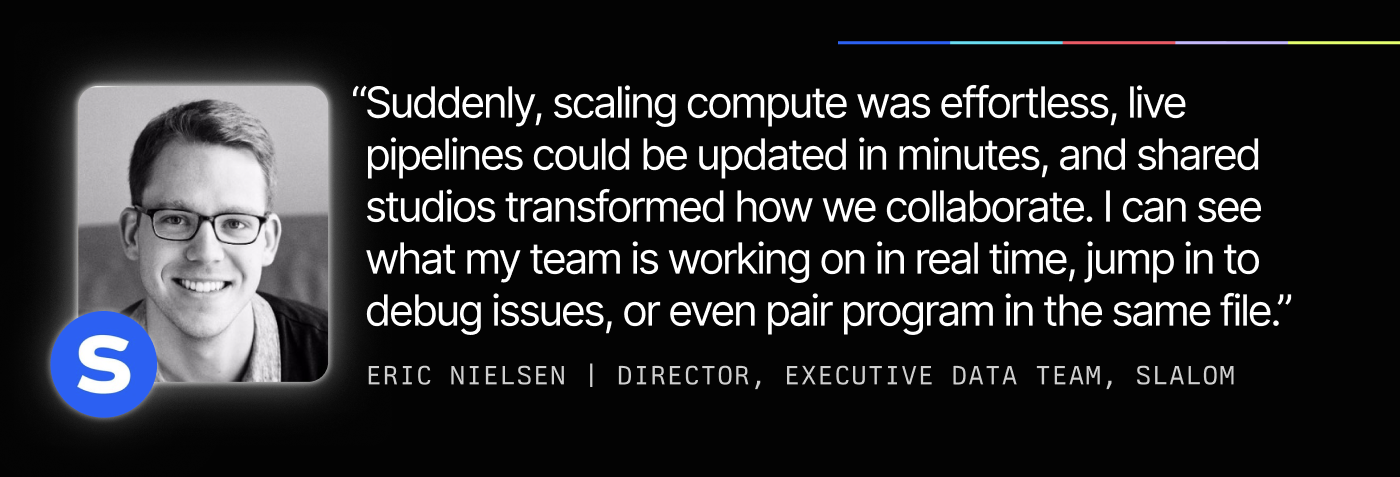
“As a very small data science team working under tight deadlines, we used to avoid cloud platforms—they demanded too much upfront setup and ongoing maintenance. That changed the moment Michael introduced us to Lightning. Suddenly, scaling compute was effortless, live pipelines could be updated in minutes, and shared studios transformed how we collaborate. I can see what my team is working on in real time, jump in to debug issues, or even pair program in the same file. Lightning has unlocked new doors for us—letting us dramatically scale our impact without having to scale our headcount," shared Eric Nielsen, Director of Data Engineering.
Speed, focus, and a path to production
For Michael, the biggest win isn’t just faster setup. It’s the ability to learn what works without wasting months chasing infrastructure problems. “In most AI projects, the real risk isn’t whether the model works,” he said. “It’s whether you can get to a proof of value fast enough to justify investing more."
That early proof shapes everything. It’s what helps teams decide whether an idea is worth scaling, whether the data is actually useful, and whether the outcome justifies the cost. Without it, teams can spend months (and tens of thousands of dollars), building systems that never deliver. “If a client already had Lightning in place,” Michael said, “you could skip weeks or months of setup and get to delivering an initial solution right away. Once viability is clear, you can have the difficult discussions about what processes and people to dedicate to owning the model in production.”
That’s what sets successful AI projects apart: not just smart models, but fast learning loops. When teams can move quickly, without reinventing infrastructure, they can get real value into production. And that’s where AI stops being interesting and starts being useful.
Fewer blockers, happier engineers
The experience wasn’t just smoother technically, it was better for the people doing the work. With shared studios and consistent environments, engineers could jump in without wrestling with cloud architecture, local installs, or permissions.
“There’s less mental load now,” Michael said. “People aren’t wondering why their notebook isn’t running or what buckets they need. They’re focused on answering business questions.”
That reliability changed how the team collaborated. Whether someone was full-time or contributing a few hours a week, they could stay in flow. No repeated setup. No stalled handoffs. Team members can just pick up where someone else left off thanks to Studios.
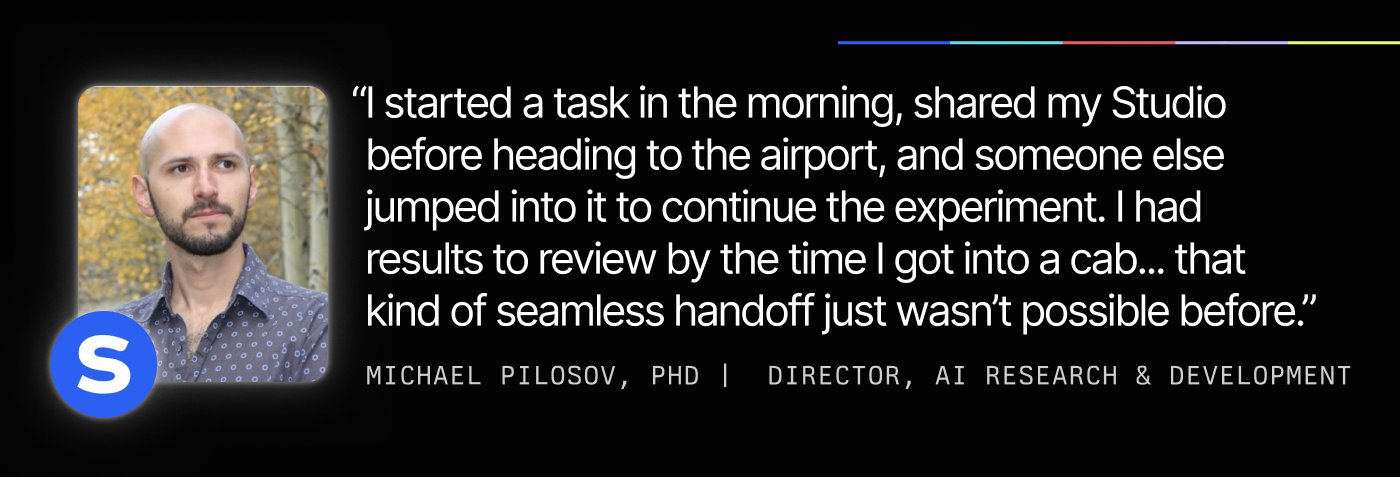
“I started a task in the morning, shared my Studio before heading to the airport, and someone else jumped into it to continue the experiment. I had results to review by the time I got into a cab,” Michael said. “That kind of seamless handoff just wasn’t possible before.”
For small teams juggling priorities, that flexibility matters. It keeps progress moving even when people move on or switch focus. For Slalom’s Executive Data Team, it means a more energized team that’s ready to deliver from day one.
Read more case studies and blogs:
• How NNAISENSE Built an AI-Powered Hedge-Fund And Cut Infrastructure Costs By 35%
• Synthera AI Brings Generative Simulations to Finance 5 Months Faster with Lightning AI
• View all