
Therna Biosciences traded infrastructure bottlenecks for research velocity on Lightning AI
Medical discoveries are a loop: create a hypothesis, pressure test against it, iterate on the results. Repeat. That process forms the backbone of what Therna Biosciences is doing right now - a loop for RNA medicine.
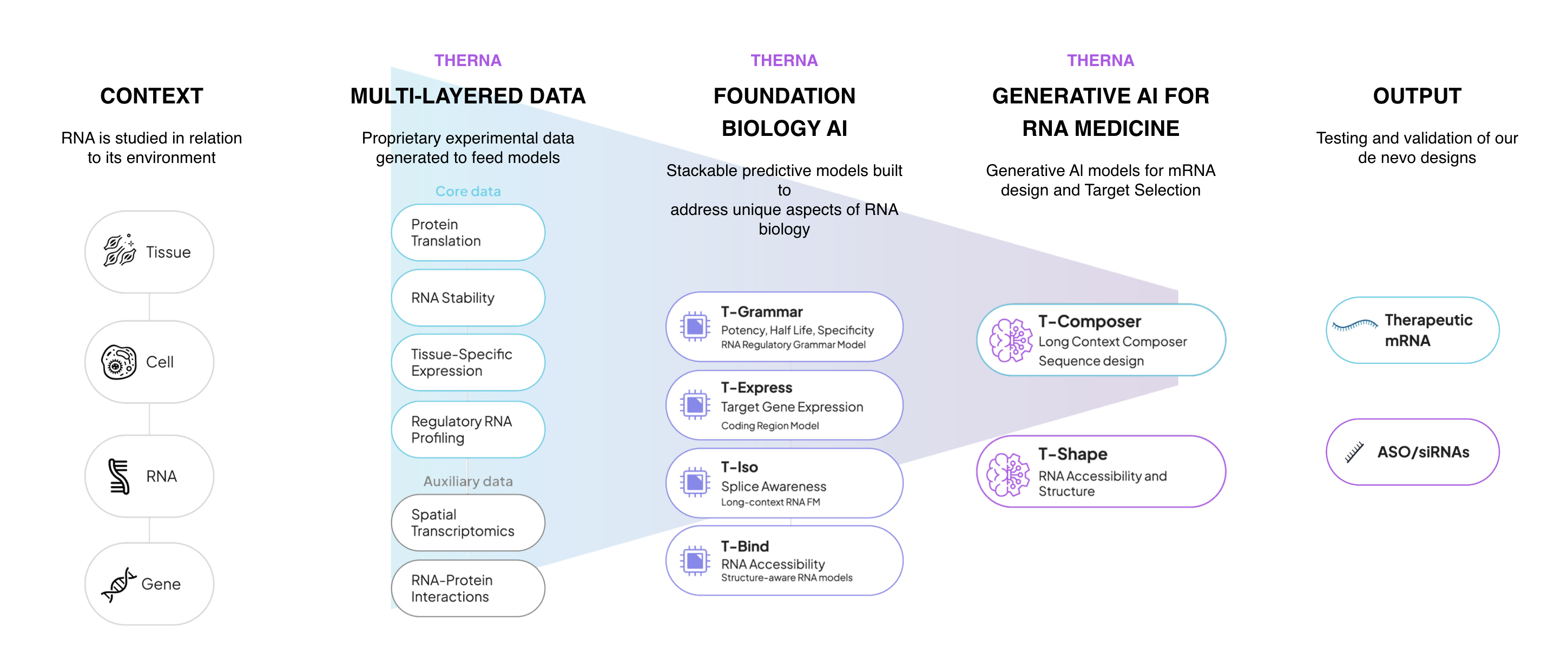
The loop is the product
AI has changed the shape of that work. A model now proposes thousands of hypotheses (or candidates) at once. It ranks them by predicting their functions, the lab tests them, and the results train the model to propose better ones on the next pass. Design becomes a loop: the model creates, the lab tests, the model learns, and the cycle repeats.
The value lives in the speed of that loop. A pass that closes in hours rather than weeks or months delivers the next generation of candidates and pulls a working therapy that much closer. But the loop runs on compute. Models train on GPUs, experiments need to start while the idea is fresh, and environments have to hold their state across runs that last hours. When compute is slow, expensive, or fragile, the loop stalls and science waits.
Therna Biosciences’ RNA-Logix™ platform generates and ranks thousands of candidate RNA sequences. Then scientists test a handful of most promising ones in the lab, and feed the results back to train models that design stronger candidates next time to find therapies that last longer and reach the right cells in a fraction of the time the old path demanded. The loop is the product, which makes the compute underneath the force multiplier that sets Therna’s pace.
The challenge: one person, two full-time jobs
Amir Momen-Roknabadi, leads Artificial Intelligence build out at Therna Biosciences. He is in charge of a team that develops and trains the RNA-Logix™ platform. As the first hired team member at Therna, Amir also had to set up Therna’s infrastructure. Right after the launch of the company, he carried the orchestration, the maintenance, and the scaling on top of the research itself, which left little room to do any of it well.
The compute layer made the squeeze worse:
- The initial single-cloud setup took up to 10 days to deliver an H100 so experiments waited on hardware that never arrived on schedule.
- That hardware cost about $11 an hour - triple market rate at the time - which raised the price of every run.
- The notebook environment lost progress when a connection dropped, so work vanished and results drifted between runs.
- GPU utilization sat at 20 to 30 percent on H100s meaning they paid for compute that never got to work.
Each problem fed the next. Slow access stalled experiments, high cost capped the number of runs, fragile notebooks erased the runs that did finish, and low utilization wasted the hardware underneath all of it.
Why Therna chose Lightning AI
Lightning AI gives RNA researchers one environment for development, training, and deployment. It removes the infrastructure work that pulled Amir away from the science.
- Compute on demand. Lightning's GPU marketplace spans hyperscalers and more than eight neoclouds, so Therna picks the best-priced available hardware and starts in seconds rather than days. The same access covers on-demand, spot, and reserved capacity.
- Cost that protects the runway. Therna reaches the same class of hardware on Lightning's marketplace at 60 to 80 percent below its prior single-cloud pricing. Lower cost per run means more experiments per dollar and a longer runway.
- Environments that hold their state. Lightning Studios persist. Amir stops an instance, returns days later, and finds every file, dependency, and weight where he left it. He clones an environment and reuses it without reinstalling anything or downloading model weights again. The lost-work problem disappears.
- Optimization expertise on tap. Will Falcon, CEO of Lightning and creator of PyTorch Lightning, helped lead a team that tunes workloads alongside NVIDIA, lifting GPU utilization 2-3x, cutting run time and spend.
- Human support that answers. When Therna needs something, the team responds and resolves it fast through a direct channel rather than a ticket queue or an offshore handoff. Responsiveness is part of the platform's value, not a bonus on the side.
What moved the needle: a Boltz-2 app built in a day
The clearest proof came when Therna needed local Boltz-2 integration for structure prediction and ligand screening. Amir set out to wrap the model in a usable web app and deploy it for the team.
He built it on a Lightning Studio. He chose a GPU from the marketplace, developed the interface, handled the long-running prediction jobs, added a 3D molecular viewer and confidence plots, and shipped a live URL through the Port Viewer. The persistent Studio held his model weights between sessions, so each run after the first started without delay.
"A year ago, wrapping an AI model in a usable web app would have taken me weeks. This time it took a day." - Amir Momen-Roknabadi, Head of AI, Therna Biosciences.
The app layers in real features: ligand support, multimer prediction, cyclic peptides, and confidence visualization that colors structures by per-residue certainty. Amir then refactored the prototype into clean modules so the team could extend it. He published the full story on his newsletter and the Lightning AI blog, and he open-sourced the code.
That single project shows the shift. The friction that once turned a prototype into a multi-week project now fits inside a day, because the environment is reproducible and the compute is one click away.
Seconds, not days, at a fraction of the cost
| Before | With Lightning AI |
| Up to 10 days to get one H100 | GPUs in seconds from a multi-cloud marketplace |
| ~$11/hr, near triple the market rate | 60 to 80 percent lower compute cost |
| Notebooks that lost work on dropped connections | Persistent Studios that hold every file and weight |
| 20 to 30 percent GPU utilization | 2 to 3 times better utilization with expert tuning |
| One person splitting time between infra and models | Lightning runs the infra, Amir runs the science |
| Weeks to wrap a model in an app | A working Boltz-2 app in a day |
Infrastructure that steps back so science can lead
Therna's mission rewards speed. Every experiment that runs sooner, every dollar that buys another run, and every hour Amir spends on models instead of orchestration brings a working RNA therapy closer. Lightning AI carries the infrastructure so the science sets the pace.
Modern tools remove friction but not responsibility. Amir and his team still validate every output and design the system with care. The difference now is cheaper iterating, reproducible environments, and capacity that scales fast.