
What if you could forecast without the past?
Forecasting is the art and science of predicting what happens next. Whether it’s tomorrow’s energy demand, next week’s sales, or future traffic patterns, forecasting helps businesses and researchers plan ahead by learning from the patterns in past data.
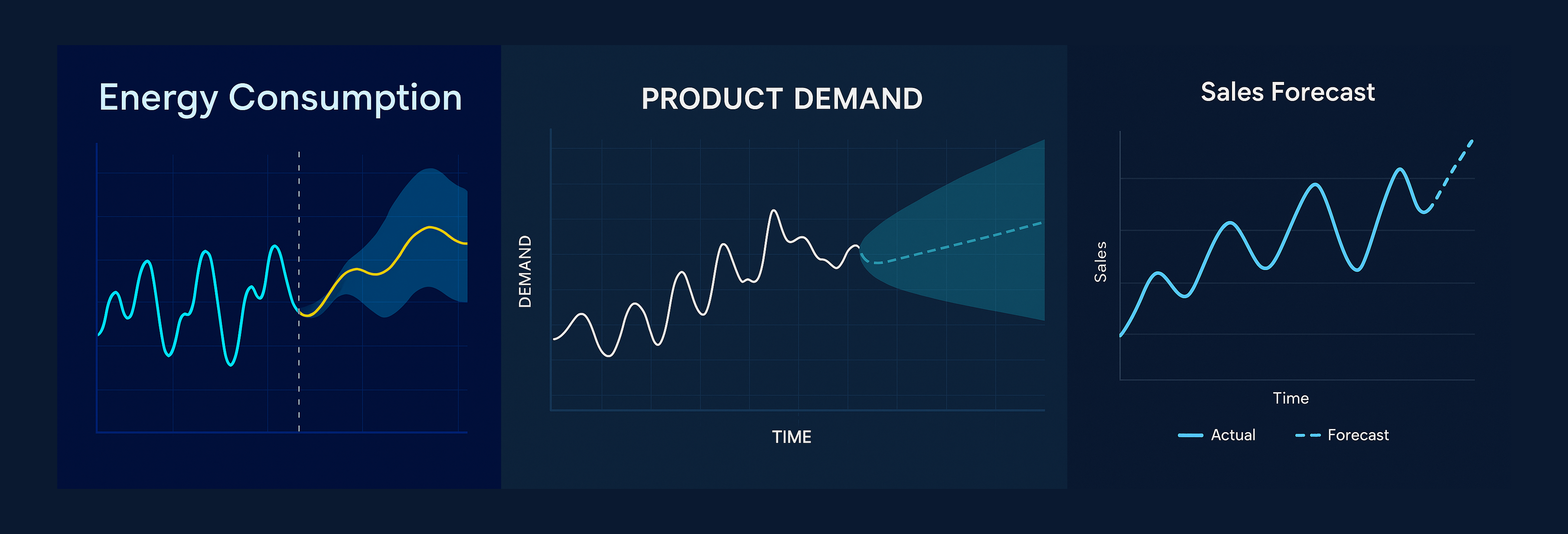
In most companies, forecasting depends on a familiar formula: collect as much historical data as possible, clean it, train a model from scratch, and hope it generalizes to tomorrow. But what if you're launching a brand-new product, or operating in a volatile market where yesterday looks nothing like today?
That’s where transfer learning comes in. And Nixtla is bringing it to time series forecasting.
Already a game-changer in natural language processing and computer vision, transfer learning lets you start with a model that’s already seen thousands of datasets so it can recognize patterns and adapt, even when your own data is limited.
Transfer learning is an exciting and under-explored technique in the field of time series forecasting. With it, we can achieve lightning-fast predictions with a fraction of the computational cost by pre-training a flexible model on a large dataset and then using it on another dataset with little to no additional training. Transfer learning thus demonstrates the potential to solve one of the most significant limitations of modern machine learning methods: the tradeoff between accuracy and speed.
Why transfer learning changes the game
Traditional forecasting models tend to break down when data is scarce, noisy, or volatile. They rely on the idea that the past will look like the future, but that’s rarely the case in real-world scenarios. From product launches to market shocks, many forecasting problems don’t come with enough history to train a reliable model.
Transfer learning flips the script. Nixtla’s pre-trained models can generate forecasts even for time series with little or no historical data. They adapt quickly to cold-start problems like predicting demand for a new product, without needing weeks of retraining. And because they’re already trained on a wide variety of time series patterns, they can handle unexpected disruptions, seasonality, promotions, and other structural changes that would trip up traditional methods.
Perhaps most compellingly, they can run fast, low-latency predictions on lightweight devices, making them ideal for IoT applications and edge environments where compute is limited. In short, they make forecasting faster, more flexible, and dramatically more accessible.
A tool anyone can use
To make this technology accessible, Nixtla built a forecasting interface in collaboration with Lightning AI, one that removes the friction of infrastructure, model selection, and setup. Users can upload a time series dataset (even something as simple as two columns: time and value), and begin generating predictions right away.
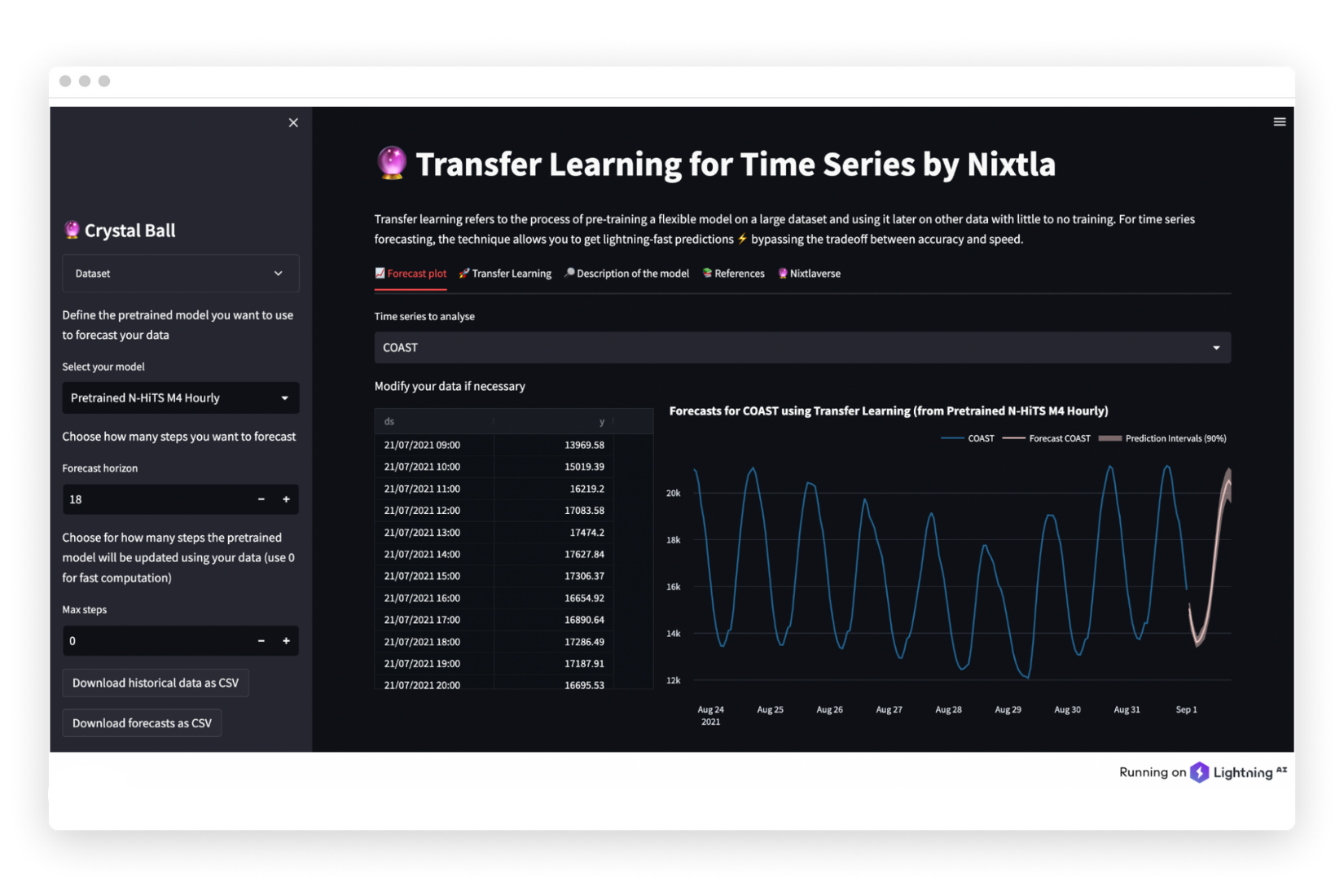
As users interact with the tool, they can compare how different pre-trained models perform on their own data, test how cleaning outliers affects accuracy, and forecast multiple time series at once by adding an identifier column. Switching models takes seconds. No pipelines to write. No GPUs to manage. No training loops to maintain.
It’s forecasting as it should be: interactive, insightful, and accessible to anyone who needs it.
Focus on AI not infra
For Nixtla, speed wasn’t just about model performance, it was about staying focused on what mattered: delivering a product. That’s why everything runs on Lightning AI Studios, a platform built to develop and deploy AI tools without the usual infrastructure drag.
They used PyTorch Lightning to train and structure their models, then deployed them seamlessly through Lightning’s cloud platform. No cluster setup. No YAML files. No DevOps engineers needed.
With Bring Your Own Cloud (BYOC) support, they could use their existing AWS account and budgets, while Lightning handled everything else, autoscaling, cost controls, job orchestration, and file management. What would’ve taken a full stack of ML engineers to manage was reduced to a few lines of code and a shareable workspace.
For a lean startup pushing the boundaries of applied research, that tradeoff wasn’t just helpful - it was decisive.
From research to real-world impact
Nixtla’s approach isn’t theoretical, it’s already being used across industries. Companies in retail, logistics, and energy are adopting their pre-trained models to make better, faster decisions without needing massive infrastructure or deep ML teams. Researchers, too, are exploring new use cases made possible by models that don’t need perfect datasets or long history windows.
This work is also being amplified by the broader open-source ecosystem. Tools like DALI, used for GPU-accelerated video processing, are being integrated alongside Nixtla’s forecasting packages to create a more powerful and efficient workflow. What once required teams of engineers and weeks of custom model tuning is now possible in minutes, with tools that are open, shareable, and production-ready.
A future that's easier to predict
When forecasting is fast, flexible, and accessible, it doesn’t just improve business performance, it changes how decisions get made. From retailers managing inventory to energy companies preparing for demand shifts, better predictions help organizations act with confidence, even in the face of uncertainty.
Nixtla’s pre-trained models, paired with Lightning AI’s platform, are helping shift the balance, removing technical and resource barriers that once made forecasting slow, expensive, or out of reach. Now, anyone with data can generate accurate predictions in minutes. No long training pipelines. No massive teams. Just results.
In a world that’s moving faster and growing more complex, that kind of forecasting isn’t just nice to have, it’s foundational. Because when more people can anticipate what’s ahead, more people can build what comes next.
The future may always bring surprises. But with the right tools, it’s getting a lot easier to prepare for them.